Finished reading on: May 10, 2020
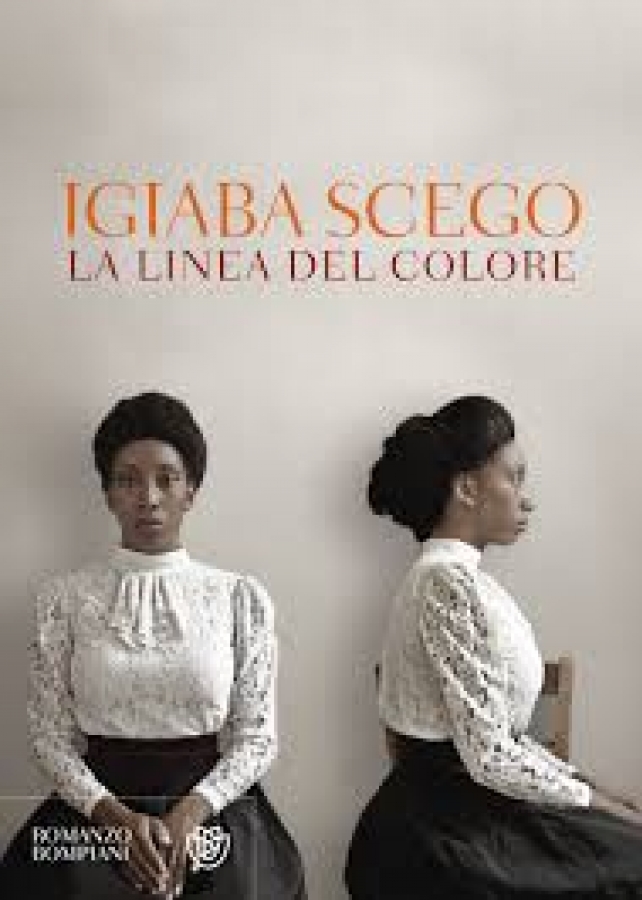
The Color Line
Title of the original version reviewed: «La linea del colore»
AI Translation Notice: This review was translated from the original Italian using artificial intelligence. Book quotes and excerpts are translated interpretations and will not match the author's original English phrasing or official published translations.
The novel is part of a trilogy that includes two other books: Oltre Babilonia from 2008 and Adua
from 2015 (reviews are available on this site). And indeed we find the same theme: the Black woman lives in a world of violence and abuse, because she is a woman and because she is Black. Taking up the narrative framework of
Adua
the author pursues two parallel stories: that of Lafanu Brown, an African American painter who lived in the second half of the nineteenth century in papal Rome, a city soft, welcoming, and roguish, and that of Leila, an Italian of Somali origin who lives in today's Rome, alluring, decadent, and cruel. They are distant eras, yet with a common starting point: the Fountain of the Four Moors in Marino, featured in Rino Bianchi's photographic gallery in the book's appendix—a deeply evocative gallery, fundamental to interpreting the entire story. Thus writes Lafanu,
those women, those ancestors of mine, because we descend from the suffering of slaves, want someone to give them a voice. Oh Lizzie dear, I see how they struggle to reach out toward us
. Leila is with a friend in Marino before the Fountain. The friend, an intelligent young woman, open to the world and a student of Arabic, says to her, laughing:
did you see that? (...) Don't you find it beautiful? (...) She too, despite her breadth of knowledge, was blind to the pain of those four black-skinned prisoners. Perhaps she hadn't even noticed they were Black
. The two stories, Lafanu's and Leila's, unfold with different rhythms and a distinct narrative style: at the root, there is always violence. Lafanu was raped as a young girl in the abolitionist American town of Coberlin, in 1859. A model student, she attended a college that took pride in having students of color. One evening, Lafanu insisted on going to the theater, wearing an elegant dress rich in color.
Every color was stripped from her. All she had left was a faint trace of mother-of-pearl in her frightened eyes and the black of her ebony skin. The black would not leave her. I will never leave you, it promised her
. Where to survive? In a place where color and surface meet. Lafanu becomes a painter; the pursuit of beauty as a lifeline brings her to Italy, to Rome. She painstakingly earns her place as an artist, enchanted by Italian Baroque and Classicism. Nightmares haunt her. She is fascinated by a painting by Lorenzo Lotto,
Santa Lucia davanti al giudice
, where in a corner of the painting a young Black servant girl holds back an unruly child. Lafanu devotes sketch after sketch to this painting.
She erases everything she considers superfluous. Everything disappears, even the child disappears; only the Black girl remains with her anxiety. A scene that Lafanu transforms into her obsession. Into the investigation of a terror
. As though beauty could free us from violence—it is an illusion! Leila, too, is Black and at the same time uprooted from Somalia:
an exile from a land that ultimately was never mine
. If you are Black, it is hard to escape violence. Binti, Leila's cousin, in an attempt to reach Italy finds herself in the traffickers' infernal circle, who rape her, just as their white counterparts did to Black people during the terrible sea voyages to America. And now, Binti
screams in silence. It is an agonizing sight: her mouth gapes wide, her eyes dilate, you expect a scream... but nothing comes from her lips." Perhaps salvation could be the meeting between color and surface. "I took a breath, steeled myself, and walked up to my cousin. (...) She stopped drawing. I was nearly struck dead with astonishment. There was a woman tied to a stake who was breaking her chains. She was weeping, and in her lap she held a passport.
Lafanu is a fictional character, a composite of two Black women who actually lived in Rome: the first a midwife and activist, the second a sculptor. The blending of reality and fiction gives the narrative a calm and evocative rhythm, like an escapist historical novel. While this diminishes the story's dramatic weight, it stimulates the reader's curiosity without generating anxiety: clearly there will be a happy ending, even if somewhat melancholy and bittersweet. Leila is the author, and the events unfold in the present day. There is of course imagination, but the raw reality of migration and human smuggling looms over the entire narrative: it slips into chronicle and indictment. The wounds inflicted upon our conscience—hypocritical and lazy though it is—are too deep for us to dally.
As was already the case in
Adua", it is truly demanding to sustain two narrative threads without making the story verbose and redundant. The sparse writing does not help create atmosphere and thus fails to support Leila's story, which often has a journalistic slant. Highly innovative, if not always entirely successful, is the blending of reality, fantasy, and the visual arts.
Why read it? It is an innovative book that develops a dramatic story