Finished reading on: May 21, 2025
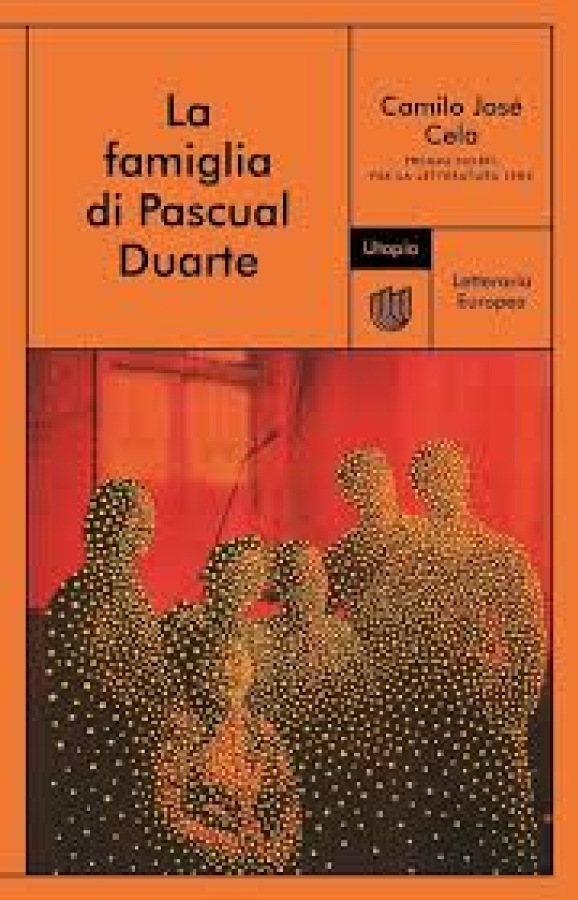
The Family of Pascual Duarte
Title of the original version reviewed: «La famiglia di Pascual Duarte»
AI Translation Notice: This review was translated from the original Italian using artificial intelligence. Book quotes and excerpts are translated interpretations and will not match the author's original English phrasing or official published translations.
Cela's long tale is a pervasive novel, fearsome and pitiful at the same time; one might wish to see it as a fresco of an ancestral peasant society dominated by violence, or consider it "a clear vision of man's vulnerability," as stated in the motivation for the Nobel Prize awarded to the Spanish writer in 1989. In reality, Pascual Duarte is not a victim; he is, quite simply, a murderer:
blood seems to be the relish to the bread of your life
, Lola, his first wife, tells him, confessing that she has a lover. To be sure, in the long letter written in prison prior to his execution, Pascual attempts to demonstrate how he was dragged along by destiny; in the long, rambling account of how he came to murder three people (his sister's lover, his mother, and Don González,
distinguished patrician
to whom he mischievously dedicates this confession of sorts), sentences recur such as: I tried to postpone
the collision that was bound to happen nonetheless, fatal as diseases and fires, as sunsets and death, because nothing could prevent it. or:
had my condition as a man allowed me to forgive, I would have forgiven, but the world is made as it is made and wanting to go against the current is not possible. After being released from prison, where he was serving the sentence for his first crime, Pascual goes so far as to accuse the leniency of the law of having dragged him
toward a worse evil. Better it would have been to stay in prison! Mad impostor or fragile soul, shaped by an unhappy childhood, by the agony
of not being able to escape evil while within us rots this charnel house of hopes stillborn.... If we take as true what Pascual tells us, we must lean toward his innocence, not before the law, but before Divine Justice: a brutal father,
tall and massive as a boulder
, a mother,
tall and thin, (...) skittish and violent
; both devoid of any moral principle and of any restraint on their instincts; and then, a simpleton brother and a sister who soon abandons the home to become a prostitute; and what of Lola, who insults him, telling him he was no man, he was just like his simpleton brother. There are the dead children, one due to a restless mare and the other to the freezing wind of Castile. Pascual harbors within himself a hatred that relentlessly erupts into a bloodthirsty fury; a monster from which it is useless to escape.
I began to run; and the shadow ran too. I stopped; and the shadow stopped as well. I raised my eyes to the firmament: there was not a single cloud across its entire arc. The shadow continued to accompany me, step by step, all the way home...(...) I would have liked to put the earth between my shadow and myself, between my name and myself, between my blood and myself, this self from which, were one to strip away the shadow and the memory, the name and the blood, so little would remain....
In the Hindu conception, every individual has their own "karma," a kind of supra-temporality of being that upon death does not follow the fate of the body but passes from one life form to another in the eternal cycle of rebirths. Pascual's karma is a bloodthirsty inclination; this is the shadow that pursues him. Pushing the interpretation, one might say that underlying the narrative lies a metaphysical vision, a timeless pessimism regarding humanity. If we bring this condition into the present, if we think of the genocide in Gaza, the massacres in Ukraine, the countless conflicts across the world, Pascual's story does not remain confined to his personal tragic plight, but constitutes a kind of apocalyptic prophecy for all of humankind. As Sebastiano Vassalli writes in 3012: The Year of the Prophet (see the review on this site), men
began slitting each other's throats with such enthusiasm that no natural or supernatural force could have stopped them. (...) Amen
.
Built around a clever literary device—a kind of rambling confession rediscovered by a mere transcriber—the novel possesses a seemingly disorganized plot, owing to the flow of overlapping memories and the lengthy interruptions in writing by the imprisoned Pascual; in truth, the narrative is handled exceedingly well, suffering, perhaps, from a lack of plot twists, if one excludes the dramatic murder of his mother. I do not know whether it is deliberate or an oversight: nowhere is the assassination of Don González recounted. The writing is effective, alternating tight dialogues with expansive, evocative descriptions of the settings and deep insights into the protagonist-narrator's state of mind. The other characters are supporting players.
Why read it? It is a punch to the gut.