Finished reading on: May 15, 2007
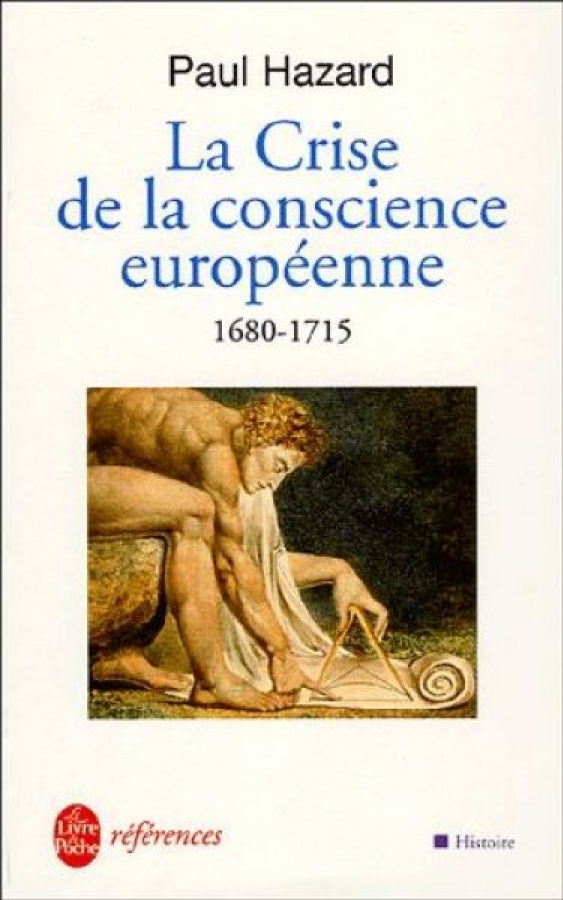
The Crisis of the European Mind
Title of the original version reviewed: «La crisi della coscienza europea»
AI Translation Notice: This review was translated from the original Italian using artificial intelligence. Book quotes and excerpts are translated interpretations and will not match the author's original English phrasing or official published translations.
The book traces the development of ideas from 1680 to 1715, a period in which, as the author states
a crisis occurred in the European mind: between the Renaissance, from which it directly derived, and the French Revolution, which it prepared, there was none more important in the history of ideas.
Man, and man alone, was becoming the measure of all things
.
The first part of the book deals with the dismantling of the past, in particular the development of opinions directed against religion.
The chapter titles are emblematic of the object of this destructive fury: major psychological shifts, and against rational beliefs.
The author dwells both on the great figures (such as Pierre Bayle, Leibniz, Bossuet) and on the cultural currents underlying the major philosophies, such as the denial of miracles, oracles, and witchcraft.
What emerges is an incredible fresco of personal histories, of interrelations among figures, of an extraordinary dissemination of books and journals, of a cosmopolitan world whose origins lie in the revocation of the Edict of Nantes, through which the Protestants were expelled from France.
In truth, the Reformation lies at the foundation of the new thought, and heretical philosophers, particularly Spinoza, are its inspirers.
Of particular interest is the figure of Richard Simon, who seeks to read sacred texts literally and grasps all their contradictions.
As Simon says,
I am convinced that one cannot read the Bible fruitfully without first knowing what pertains to textual criticism.
As Hazard puts it,
they were born rebels….
curt, presumptuous, they likened all of history to a sheet of paper full of bad creases: those creases had to be smoothed away, and a return made to the blank page, that was all!...
the world was full of errors, generated by the deceptive faculties of the soul, warranted by unchecked authorities, spread under favor of credulity and indolence…(they) had first and foremost to make an immense clean sweep
.
The second part of the book concerns the construction of the future, and specifically the path that will lead to the predominance of Reason, that is, of the scientific method.
Here too, the author dwells on the contribution of great men—first and foremost Locke, Newton, once again Leibniz, and Vico—but above all he explores the subterranean changes, what Hazard calls imaginative and sensory values: the picturesque, the psychology of uneasiness, and so forth.
What emerges is a fresco rich in suggestiveness, succeeding admirably in depicting the contemporaneity between high
thought
, which seeks to trace reality back to a rational approach, and subterranean currents that preserve magical elements within society.
Modernity is thus born two-faced, but its engine is fueled by uneasiness, by the desire for exploration, by the pursuit of a happiness that can no longer be deferred to the hereafter.
A philosophy that renounces metaphysics and deliberately restricts itself to what it can immediately grasp within the human soul.
A morality that fractures into multiple moralities: the recourse to social utility, just to choose one.
The right to happiness, to happiness on earth….
Science, which will ensure the indefinite progress of man and therefore his happiness
.
Tolerance as a virtue (one need only think of Locke’s Epistola de Tolerantia) and then the first traits of Romanticism found in Locke’s concept of uneasiness:
and it will not perhaps be useless to observe that uneasiness is the chief spur exciting men's industry and activity
.
Uneasiness consists in the longing for what we lack, but also in the hope and confidence of being able to obtain it.
What remains of this bubbling of ideas today? The critical spirit has been extinguished in a flood of empty words, the scientific method has shattered into methodologies and techniques; man has consequently lost faith in the future, and the
magical
, irrational beliefs have regained vigor.
Uneasiness has turned back upon itself.
What must be done? Cast books to the nettles (as Olmi’s film Cento Chiodi seems to suggest) and plunge into empathy with others and with nature? Or calmly pick up the threads of an interrupted discourse, restoring faith in the scientific method? As Vico said,
yet in such a dense night of darkness….
there appears this eternal light, which never sets, of this truth…: that this civil world has been made by men, whence its principles can, because they must, be refound within the modifications of our very own human mind".