Finished reading on: March 08, 2012
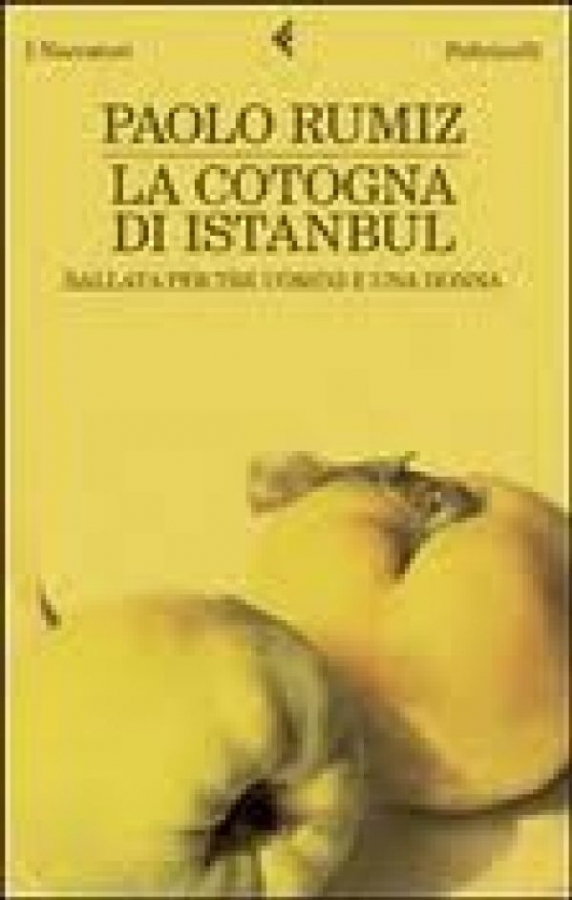
The Quince of Istanbul
Title of the original version reviewed: «La Cotogna di Istanbul»
AI Translation Notice: This review was translated from the original Italian using artificial intelligence. Book quotes and excerpts are translated interpretations and will not match the author's original English phrasing or official published translations.
The quince is
the only fruit that with time can make its fragrance grow stronger rather than languish.
It is ugly, full of bumps, but with time it grows rounder, softer, more beautiful and feminine
.
The tale is the chronicle of a tenacious love, for a land and for a woman.
The land is Bosnia, “the land of long loves and long grudges.”
The woman is Masa, “a Tatar face, eyes like black grape berries.”
Fate has it that the woman’s fiancé is arrested just days before the wedding.
Masa,
flowing dark copper hair, stubborn as a partizanka and strong-willed as a Bosniak woman
, waits for her man for ten years (in fact, in the meantime she marries and has two daughters, but it is an interlude of no consequence in the tale, whose purpose remains baffling).
When the man returns, after a few days he is killed by a grenade, and then
for Masa the beautiful...
an affair ended that had lasted ten years of waiting—if you catch my drift—and ten days of leave
.
It is at this point in the story that Max steps in, an Austrian engineer who falls in love with Masa and through her with Bosnia and Sarajevo, because
nowhere can you better understand the destiny of Europe...
where the last illusion (of great universal brotherhood) had died, toward the houses around the airport riddled with the marks of Armageddon
.
Yet Max’s great love for Masa is also destroyed, this time by the tumor that will lead to her death.
At the news of Masa’s loss.
Max becomes convinced that
only one thing could have halted that cursed fate: it was the fruit he was supposed to fetch, and perhaps had not fetched in time, the mysterious zuta dunja, the yellow wonder of the imperial city.
And instead Masa, the belle of Bosnia, with eyes like black grape berries, had died aman aman without ever receiving that quince awaited from Istanbul
.
And so Max sets off on foot in search of the quince.
At this point, the story becomes so muddled that all we can say is that Max dies mysteriously in an Istanbul hotel.
It often happens that a writer who is very accomplished in one literary genre seeks to test himself against domains, narrative structures, and modes of writing that are not
congenial to him, with failure as the result.
Consider Ken Follett, who with Eye of the Needle had written a fine thriller, only to then
devote himself to massive historical novels, through which it became abundantly clear that he was neither Tolstoy nor Victor Hugo.
Such is the case with Rumiz, an excellent
journalist who set out to tell a story, already muddled in its own right, in the form of a long ballad.
What came out of it is a verbose,
fragmented, tedious, irritating singer-songwriter ballad.
Relying on suggestive impressions and evocative effects may work well for a song consisting of a few stanzas, but enduring all this for some two hundred pages is truly too much.
The truth is that not everyone knows how to craft an epic poem!
Why skip it? It is irritating, superficial, and dull.