Finished reading on: September 08, 2013
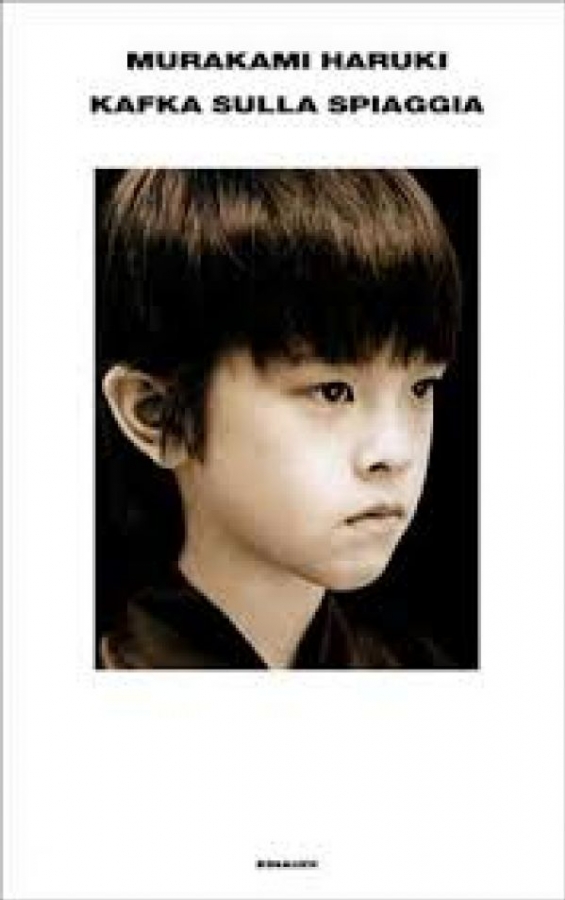
Kafka on the Shore
Title of the original version reviewed: «Kafka sulla spiaggia»
AI Translation Notice: This review was translated from the original Italian using artificial intelligence. Book quotes and excerpts are translated interpretations and will not match the author's original English phrasing or official published translations.
I was about to enter the ruthless world of adults, and there I had to survive on my own.
Dovevo diventare più duro di chiunque altro / I had to become tougher than anyone else
.
First and foremost, the book is a bildungsroman, taking its cue from a short story by a major figure of Japanese literature: Natsume Soseki.
He recounts the story of a student who runs away from home to work in a mine, undergoing an "experience of life and death" before returning to his former world.
The singularity of Soseki's text lies in the fact that it never reveals whether the young man has changed.
Reading it, one has the impression of "not understanding what it is meant to signify."
Similarly, fifteen-year-old Kafka Tamura, one of the two protagonists of Haruki's novel, flees his hated paternal home to escape the pain of having been abandoned by his mother.
He is weighed down by a tremendous spiritual wound, one that can only be overcome by accepting his mother's rejection without expecting explanations.
He simply has to forgive her.
It is an arduous existential passage, not least because doing so would bring him definitively into maturity, to the realization that all of us are like a mask in a Greek tragedy:
light and shadow, hope and despair, laughter and sorrow, trust and solitude
.
It is no coincidence that in a book steeped in metaphor, the library and the forest are the most crucial symbolic constructs of Tamura's inner journey. Having run away from home, Tamura finds shelter in a private library, where he befriends the clerk—a sort of philosopher, part man and part woman—and, above all, meets the woman who might be his mother, Miss Saeki, with whom he makes love.
Yet the library is the symbol of the orderly arrangement of memories, without which we could not survive.
We all keep continually losing so many important things...
living means this too, but each of us has a little room inside our head where we can keep all these things in the form of memories
.
Walking in the forest, on the other hand, symbolizes the search for a world apart, motionless, serene because it is devoid of memory.
And indeed Tamura ventures ever deeper into the woods to reach
a particular place in my being, the luminous source where darkness is spawned and soundless echoes are born
.
There, in an unreal village, he may find that inner peace which constantly eludes him because he unceasingly wonders:
why didn't she love me? If my mother didn't love me, could it not have been because of some grave, fundamental flaw of my own?
.
Yet how did Tamura manage to enter this world,
where time is no longer needed and (therefore) memories are not needed either
? Here enters the parallel storyline running alongside Tamura's journey.
Nakata has suffered the effects of a mysterious phenomenon that occurred during the Second World War.
Still a child, he fell into a coma for several days and then, upon regaining consciousness, lost all memory, forgetting everything—even how to read and write.
Ever since, he has remained somewhat impaired, endowed with strange and seemingly useless powers: for instance, he can speak with cats, as he knows the language of all living beings.
Here, too, the author draws upon an ancient Japanese legend according to which there exist "living spirits" that possess the prerogative of leaving the body, traveling to faraway places, and dwelling at the edges of the world.
Well, Nakata seems to possess these very qualities.
His quiet life as an elderly man, somewhat odd yet harmless, is abruptly shattered because he is forced to kill a person who beheads cats (a man who is none other than Tamura's father).
Nakata sets off on a journey partly because he feels he must carry out a mission: to seek the entrance stone, that is, to allow Tamura to enter the timeless world.
And this is crucial for the boy, because transcending the boundaries of the real world allows him to meet his mother, forgive her, and accept coming of age.
I find myself trapped between one void and another.
I cannot tell right from wrong.
I do not even know what I am looking for.....
yet from somewhere Miss Saeki's voice reaches me, saying in a firm tone: it doesn't matter, you have to go back anyway.
I am the one who wants it.
For you to be there
.
Narrating events and circumstances on the brink of the absurd allows the author to dispense with the criteria of verisimilitude and transport us into an oneiric world, belonging to dream rather than reality.
At the outset, the narrative is structured like a classical novel; then, as one proceeds, the reader is no longer astonished by the events and characters, growing convinced that the author is recounting a dream, a journey through consciousness in which the different levels—rational and irrational—somehow merge and achieve a unified conception.
One is in the presence of a book bearing strong philosophical undertones, with frequent recourse to symbolism and words laden with manifold meanings.
It is a pity.
Poised between psychological inquiry and fantastical tale, all too often inclined toward philosophical digressions, the story loses concision; the narrative's forward momentum dissolves, remaining in the end suspended without a definitive resolution.
One is left with the sensation of having read something fascinating yet evanescent,
like water lingering in a small hollow in the ground on a summer morning before evaporating in the sun
.
Why read it? It is well worth reading, but one should expect neither an easy read nor a clear conclusion.