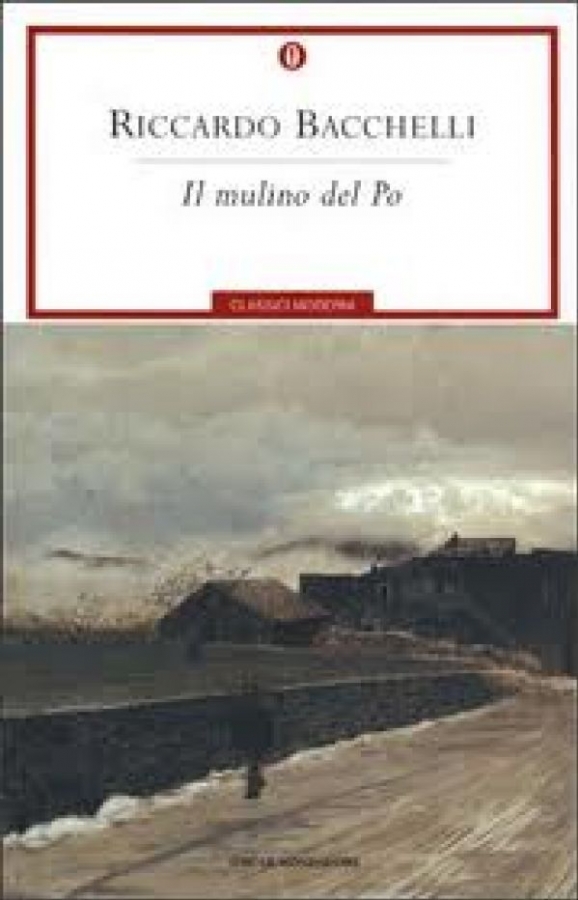
Finished reading on: January 18, 2012
The Mill on the Po
Title of the original version reviewed: «Il Mulino del Po»
AI Translation Notice: This review was translated from the original Italian using artificial intelligence. Book quotes and excerpts are translated interpretations and will not match the author's original English phrasing or official published translations.
Il Mulino del Po is defined by its author as a historical novel, chronicling the fortunes of a family of millers from Ferrara between 1815 and the First World War.
Bacchelli’s aim is to narrate the history of Italy from the perspective of the humble,
to win for poetry a century, a moment of the mighty humility of the common people, civilized in Italy with a civilization of their own, at times evasive and secret, yet always unmistakable and never crushed by so great, so illustrious, and yet so heavy a burden of history
.
In the first volume, Dio ti salvi, Lazzaro Scacerni finds himself, despite himself, swept up in the great rout of Napoleon's army in Russia.
During the disastrous retreat, a dying Italian officer reveals how to recover a cache of precious sacred objects looted from the churches of Ferrara during the Jacobin era.
Having returned to Italy, Scacerni uses the proceeds from selling these objects to build a watermill, the San Michele, thus becoming a miller of the Po.
Until 1860, the Po served as the border between the Papal States and Austria, a hotbed of smuggling frequented by thieves and scoundrels.
Scacerni is blackmailed by a fence and gang leader, the Raguseo, to whom he had sold the precious items.
Just as he resolves to kill the Raguseo, the latter is murdered.
Scacerni saves both himself and his soul.
The question arose explicitly during the long, brooding hours beside the millstones of white and yellow flour, as he reflected on all that God had wrought to save him: and why did He do it? Yet he understood there was no answer, save in an act of grace
.
The second volume, La miseria viene in barca, centers on Giuseppe—nicknamed Coniglio Mannaro—son of Lazzaro, and Cecilia, daughter of the Matto di Paneparso, another Po miller.
On a stormy day, Cecilia’s mill is swept away by the tumultuous current and saved by Lazzaro, who virtually takes the girl in as his daughter.
Coniglio Mannaro rejects his father’s trade and, greedy for money, embarks on a career as a broker, often by dishonest and unscrupulous means.
Cecilia, by contrast, is rugged, wild, and upright, devoted to the mills and the Po.
Coniglio Mannaro tricks Cecilia into marriage, and she bears him seven children.
The two spouses remain forever estranged, deeply divided by their values and allegiances: Cecilia bound to the river and the children, Giuseppe to the land and to money.
Above all, she is revolted by her husband’s dishonesty in personal relationships and business dealings.
But retribution
would come from the river; of this she was certain, born as she was in a land where everything—the land itself, good and evil alike—was given and taken away by the river, so that river and fortune were one and the same
.
Indeed, during the great flood of 1872 (among the book’s most gripping pages), Coniglio Mannaro loses his lands, swallowed forever by the waters of the great river.
In a dramatic scene, amid the height of the storm, Cecilia rescues her husband, who, driven mad, had lingered on the embankment and was about to be swept away by the raging waters.
In the third volume, Mondo vecchio sempre nuovo, Cecilia, battling poverty and hunger, is forced to send two of her daughters into domestic service.
One of them, the fair and virtuous Berta, goes to work for a peasant family, where a young man, Orbino, has long been in love with her.
In a magnificent chapter, I giorni della ghirlanda, which ought to be read in every school, Bacchelli retraces the cycle of rural life throughout the year up to the harvest festival.
These pages reveal the author’s profound love for the countryside and the life of the peasantry.
Yet alongside the passage of the seasons, the love between Berta and Orbino matures—a modest, well-guarded love, for the two youths have resolved to "fare la prova" (as consummating love before marriage was called back then) only once their union has been sanctioned by their families.
A curse weighs upon the destiny of the Scacernis, born of an original sin.
It is an era of struggle in the Ferrarese countryside between landowners and the peasant league.
Cecilia sides with the masters, solely because she is a woman of the river, bound to tradition, who refuses to take orders from the peasants.
Not only must the two young lovers part, but the hatred toward the Scacernis leads to slander against Berta to such a degree that, in a moment of madness, her brother murders Orbino.
As in a Greek tragedy, on the banks of the Po, one witnesses the ritual purification of the poor youth's corpse by his unconsummated, chaste bride.
For Bacchelli, this is a metaphor for life and death.
The world is no more than misfortune, against which rebelling is even more futile than suffering.
To be born is nothing other than to come here to die, as vain as the flowing of the river....
like the river giving up corpses, man's hour dissolves into the time that bears it.
There hope falters, charity dies, faith is lost
.
Just as the saga of the Scacerni family comes to a tragic close, so too ends the history of the mills of the Po, supplanted by steam mills.
And with them dissolves the hope of Bacchelli the man and of his world, that of the peasantry.
A family, a people, a land: I did not invent them, I came upon them....
he who has told their tale suddenly feels the void
.
It is a great book, open to multiple readings.
First and foremost, there are the great river and the Ferrarese landscape.
This is the most compelling aspect, not merely as a historical testimony, but for the author's ability to depict both the world of the waters and that of the peasantry.
Secondly, Bacchelli creates an expansive historical fresco of Italian history, grounded in the contrast between the waning values of the Risorgimento and the resilience of the Italian people—a strength the author traces back to the Catholic faith.
And here Bacchelli’s nostalgia emerges unmistakably for a world that modernity has weakened, engulfed, and radically altered: that temporal realm of the popes, which may have been hypocritical, antiquated, and rife with privilege, yet allowed poor folk to survive without being crushed by an extortionate landlord, by taxes, and by the trade union leagues themselves, which the author sharply criticizes.
Finally, there is the religious theme: God’s mercy is mysterious, yet it unfailingly operates to grant the righteous their due.
Why read it? Reading the work in its entirety is very heavy going, as Bacchelli struggles to sustain the narrative momentum; nevertheless, certain passages, particularly those bound to the natural environment, are strikingly beautiful and insightful.
It is best read as a curated selection of excerpts.