Finished reading on: August 09, 2009
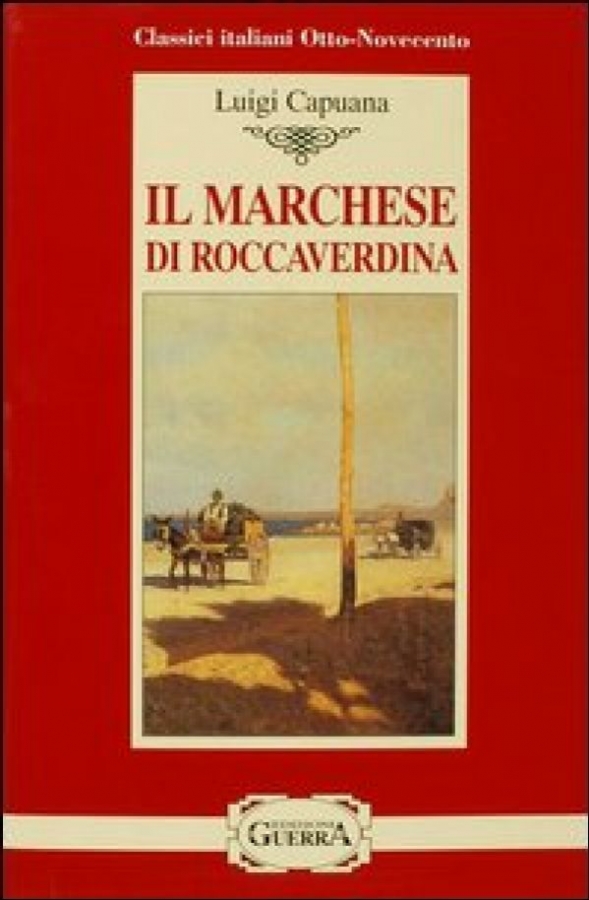
The Marquis of Roccaverdina
Title of the original version reviewed: «Il marchese di Roccaverdina»
AI Translation Notice: This review was translated from the original Italian using artificial intelligence. Book quotes and excerpts are translated interpretations and will not match the author's original English phrasing or official published translations.
The setting is the Sicilian countryside of the second half of the nineteenth century.
Rabbàto is a small town, long awaiting rain to put an end to the drought that is driving the entire community to destitution and hunger.
The Marquis of Roccaverdina is a wealthy landowner who lives as though the world were immutable and acknowledged his boundless power over things and people.
He had long taken a peasant woman, Agrippina Solmo, as his mistress.
To keep up appearances, he decides to give her in marriage to his bailiff, on the condition that the marriage must remain unconsummated.
Jealousy drives him to murder the bailiff and then to orchestrate the conviction of a poor peasant, who will perish in prison.
He feels no true remorse for these outrages (the abandonment of his mistress, the murder of the bailiff, and the condemnation of an innocent man), since, after all, they are merely common folk and to the Marquis of Roccaverdina everything is permitted.
Rather, he senses a creeping fear, “the usual apprehension of perils lurking in the shadows.”
The abandoned mistress and the murdered bailiff “would suddenly appear and just as suddenly vanish,” and
he felt the strange sensation of walking upon unstable ground that might collapse beneath his feet at any moment
.
It is cowardice that acts as the catalyst driving the Marquis—previously so confident in himself and his social standing—to doubt, to reflect upon the very existence of God and the validity of religion, upon mankind, and upon himself.
In vain, he seeks solace in feverish activity, throwing himself into politics, launching an enterprise to modernize wine production, and marrying a local noblewoman.
Only the sight of the countryside, bathed in rain, affords him a measure of peace:
let us leave this subject, for now.
Look.
The countryside looks like a garden! An immense expanse of green, in a thousand shades of green, from tender to somber, almost black; a triumph, a frenzy of vegetation even in the most unyielding soils, which had never borne a single blade of grass!
The suicide of a peasant, from whom he had extorted land through threats and abuse of power, unleashes the madness that leads the Marquis into dementia and, ultimately, to death.
In his final illness, only his mistress remains at his bedside to attend to him, a testament to a love that transcends social hierarchy.
Yet appearances prove stronger than affection: the poor woman cannot remain at the moment of the Marquis’s passing, and she
let herself be dragged away, offering no resistance, humble and resigned as she had always been, convinced herself that she could no longer remain there, because her destiny had willed it so!
It is a complex novel: on the one hand, a rigid and immutable social order within which the characters move according to predetermined roles; on the other, the figure of the Marquis of Roccaverdina, who seeks to break these social moulds, both from an economic standpoint (new crops, modern processing methods, technical innovation, cooperative models among producers) and in the realm of personal affections and feelings.
The Marquis has no love for his own social milieu; he feels far more at ease among the peasants, with the old servant woman who raised him, and with the mistress for whom he killed.
His madness stems precisely from the contradiction between an unfettered, almost “superhuman” will, and the inability to shake off cultural and social conditioning, superstitions, and the dread of divine retribution.
Why read it? It is an absorbing read and a strikingly modern novel.
The figure of the Marquis of Roccaverdina is emblematic of an inner conflict typical of our own time.