Finished reading on: June 18, 2021
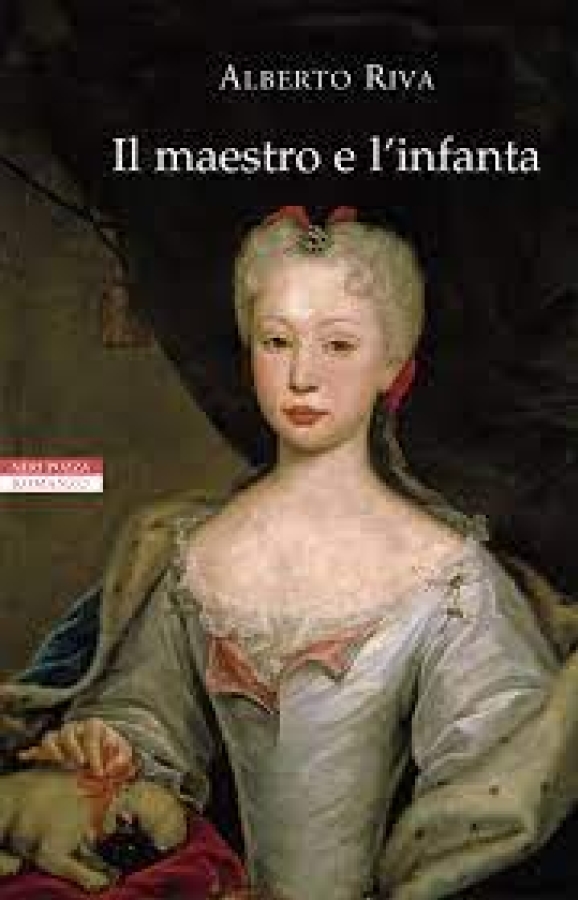
The Master and the Infanta
Title of the original version reviewed: «Il maestro e l'infanta»
AI Translation Notice: This review was translated from the original Italian using artificial intelligence. Book quotes and excerpts are translated interpretations and will not match the author's original English phrasing or official published translations.
In Canto XVII of the Paradiso, in verses 43–45, Dante recounts that his ancestor Cacciaguida turns to music to explain his vision of the poet's impending exile:
thence (from the divine mind), even as to the ear comes / sweet harmony from an organ, so comes / to my sight the time being prepared for you
. The sound of an instrument's strings, together with the sweetness of the voice, is a divine gift granted to humankind to soothe the wounds of both body and soul—and, for Dante, to endure the prophecy of his sorrowful wandering. Is this true, or is music merely a palliative? If we probe Alberto Riva's novel beneath the surface, we must conclude that while music induces a kind of wondrous bewilderment, it can do nothing to heal loneliness, depression, and madness. We are in the eighteenth century, between 1720 and 1758; Domenico Scarlatti, son of the more renowned Alessandro, arrives in Lisbon to become a musician in one of the wealthiest courts of Europe at that time. Domenico
is a man in his late thirties who looks a few years older, with a prominent knobby nose and eyes of a shifting hazel, distant, perhaps flawed by a slight squint: his skin is exceedingly pale and his clothes black, a resolute, mournful black. (...) For years, his father kept him bent, almost kneeling over the keyboard for hours on end every day, especially at night
. Shy to the point of rudeness, he is certainly neither the classic cicisbeo nor a man of polished manners, as the elegant and vacuous society of the eighteenth century would demand. And perhaps precisely because of his sullen and independent nature, he is unwilling to endorse the sovereign's wish to stifle the musical inclinations of the Infanta, the plump and rather plain Maria Barbara. Instead, Domenico becomes her tutor, refining and exalting the girl's natural gifts; a bond is forged that will endure over time, even after Maria Barbara marries the heir to the Spanish throne and subsequently becomes queen. Any composer of the age, from Vivaldi to the singer Farinelli, would have seized upon such circumstances to secure fame and wealth. Not so Domenico Scarlatti; driven by a somber frenzy, he vanishes into taverns, where
he listens to imaginative arrangements transposed onto the strings, carried by female voices
. In Inquisition-era Spain, he frequents the world of the gypsies, where he discovers that
within that Andalusian folk lay a buried civilization, and that civilization was music. That the guitarra is the unwritten book through which a history is handed down. But it is not just the guitarra: it is the hands, the voices, the fingers, even the feet. (...) They ask us why our singing is deep (explains the old gypsy). They ask us for the secret of cante.....And we answer: our singing is the search, our singing is the journey. (...) a mysterious drama, a drama without an ending
. All his life Domenico pursues something indefinable, and finds it, perhaps, by wandering through the poorest, most disreputable quarters.
Anyone who had caught the maestro unawares on one of those nights would have seen him slightly slumped, an elbow on the table, one leg stretched out, a certain look in his eyes. (...) He looks at his hands: his relationship is with the instrument. (...) His relationship with the instrument is one of interrogation. Of progressive unveiling
. Had it been up to Domenico, the musical exercises—the famous Scarlatti Sonatas—would have been lost: perhaps the musician deemed it futile to leave behind compositions incapable of soothing his male oscuro. It is to Maria Barbara's credit that we know them today.
The novel's framework is something poised between historical reconstruction and an introspective inquiry into the two protagonists: Domenico Scarlatti and the Infanta Maria Barbara, as well as the idiosyncrasies of their relationship. Music, and the mysterious allure of the Sonnets, have prevailed over a narrative that might have placed the two protagonists on equal footing: Maria Barbara remains in the background, flattened by the duties and demands of her station; beyond the fascination of the musical exercises composed by the maestro, what truly bound Maria Barbara to a man so withdrawn and discourteous? The only significant element is Maria Barbara's stubbornness, her determination to preserve Scarlatti's work and bring him renown. Could a repressed love for the man have driven her? We shall never know, because the musical and biographical genesis of the Sonnets took precedence, consigning Maria Barbara once more to the oblivion from which the author had sought to rescue her.
The prose is plain and flows placidly, neither attracting nor repelling. Only when the author depicts glimpses of Lisbon do impressions rich with vivid colors emerge. Here is Lisbon, perhaps frequented and beloved by the author:
something grim, that smell of dissatisfied souls, of unhappy men, (...) and then the city, opening onto an estuary that is already the sea, composed of shifting colors, of ascents and descents, of sudden azures, turquoises, ultramarine blues.
And the City understands/And kindles/ And the flame titillates and absorbs/ The magnificent remnants of the sun/And weaves a shroud of oblivion/ Divine for weary men
. (Dino Campana, Genova in Canti Orfici).