Finished reading on: September 12, 2023
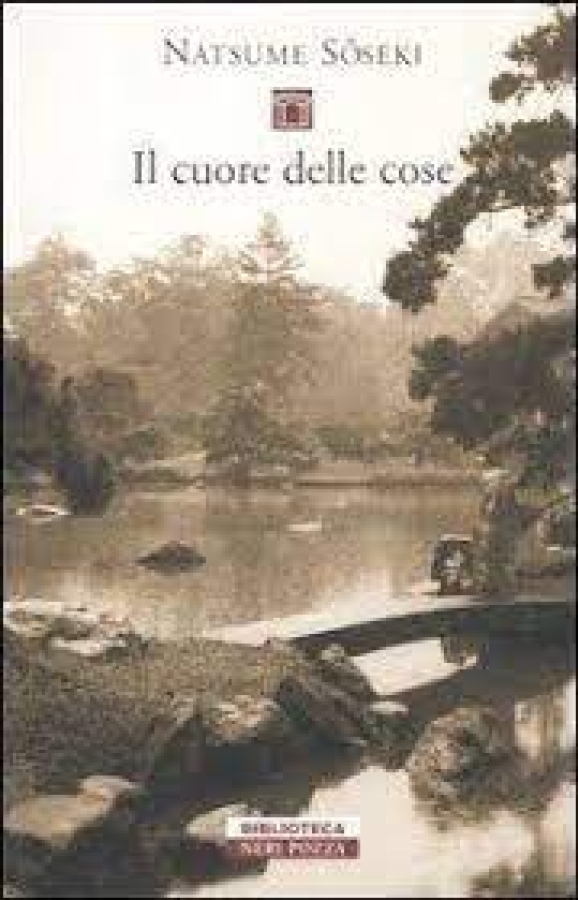
The Heart of Things
Title of the original version reviewed: «Il cuore delle cose»
AI Translation Notice: This review was translated from the original Italian using artificial intelligence. Book quotes and excerpts are translated interpretations and will not match the author's original English phrasing or official published translations.
The novel is set in the early twentieth century, at the close of the Meiji Restoration or Renovation: the prolonged era between 1867 and 1912 that began with the reassertion of imperial power over the Tokugawa Shogunate. This historical anchor serves not only to contextualize the narrative—centered on the ambiguous and complex relationship between two generations—but also to underscore its contemporary relevance; much like today, we find ourselves in a period of transition in political and social structures, as well as in consciousness and sensibilities. A young student meets an older man, identified only by the appellation of "master." He is captivated by him—drawn to his taciturn, gruff demeanor, his solitary lifestyle detached from society and fellow human beings, and his ever-cryptic musings on love, honor, and money. In an ambiguous fashion, the master exerts a kind of blackmail over the young man: the foreboding expectation of betrayal.
I am a lonely man, but in a sense, aren't you as well? (...) In meeting me, you probably feel a certain loneliness. But because I lack the strength to help you break free from it, you will now turn elsewhere and no longer come to see me. (...) "You may think I might drift away," (the young man replies). (...) The master seemed not to be listening to me. "Yet you must be careful, for there is guilt in love. If you stay with me, you will find no satisfaction, but neither will you run any danger."
Few clues offer a glimpse into what lies behind the master’s misanthropy: he regularly visits the grave of a friend whose death reportedly transformed the man’s character, without the reasons or background of this change being disclosed. Following his graduation, the young man returns to his parents’ home while waiting to find employment. His father is gravely ill, already nearing the end.
My melancholy tended to shift alongside the shifting shrill of the cicadas, as though the destiny enveloping me were moving by degrees through a vast cycle of different existences.
The young man is torn between filial affection and duty, which urge him to remain at his father's bedside, and the longing not to sever ties with the master.
To me, the master was a shadowed figure, and I would not have been satisfied until he revealed himself entirely.
A lengthy letter, preceded by urgent telegrams, drives the young man to commit an unforgivable act: he abandons his dying father to rush to Tokyo to the master. What does the master write in this sort of ethical testament? It is as though the young man had fulfilled a hermeneutic function.
I would rather see my past erased along with my life than offer it to someone who does not desire it. In truth, had it not been for someone like you, my past would never have been known to anyone, even indirectly. To you alone, then, among millions of Japanese, do I intend to recount my past, because you are sincere.
There is no need to delve into the master's expansive confession, which unburdens his guilt onto the young man’s fragile shoulders. Suffice it to say that he acted dishonorably—he who considered himself steeped in virtue. He drove a friend to suicide by laying bare the contradictions between the friend's spiritual aspirations for an ascetic life and his romantic longing for a young woman, who was also loved by the master.
And so, despite my earnest desire to pursue an honest life, I strayed from it. I was a fool, if you will, a cunning and arrogant man. (...) Inside me arose, like a vortex, the feeling that I had won by cheating, and that I had been defeated as a human being.
In the fine preface, expressively titled "Soseki: Solitude as Art," Gian Carlo Calza retraces the author's personal and literary biography, defining Kokoro (Il cuore delle cose) as "a faithful account of the author's own life or destiny." When one considers that none of the novel's protagonists bears a name, and that already in a 1905 work (I Am a Cat, see review on this site) Sōseki had played upon two characters (the feline narrator and the tedious English teacher) to depict the different facets of a single personality, one might suggest that the young student, the master, and the friend represent distinct vantage points for probing the author’s character: the youth embodies the fragility of a hope-filled youth; the suicidal friend signifies the search for spiritual anchors in an era of transition; and finally, the master is Sōseki himself, now disillusioned, locked in individualism and a pessimistic vision of life and Japan. If we step away from the author's biography and make a bold leap into contemporary Italy, the relationship between the young man and the master seems to keenly capture the intergenerational crisis afflicting our country. We, the "baby boomers," are the bad mentors who dispense nuggets of wisdom and fine rhetorical phrases, yet like Sōseki's master, we are dishonest because we are manipulative—shielded by our pensions, our conduct far removed from our pompous pronouncements. The young are the student: naive, filled with aspirations, fleeing from the false guides in whom they no longer believe! This modern transposition is also hinted at by the theatrical adaptation of Kokoro (Il cuore delle cose) in Kenzaburō Ōe's work (see the review of The Changeling [La foresta d'acqua]), where the master is viewed as a "false educator" by the high school students attending the performance.
In an elegant and lucid manner, the author investigates the psychological and moral entanglement between the master and the young man, as well as between the former and his suicidal friend. The narrative unfolds slowly, at times repetitively; the extended letter bears too heavily the hallmarks of a soliloquy to escape being prolix.
Why read it? It prompts numerous reflections on the present.