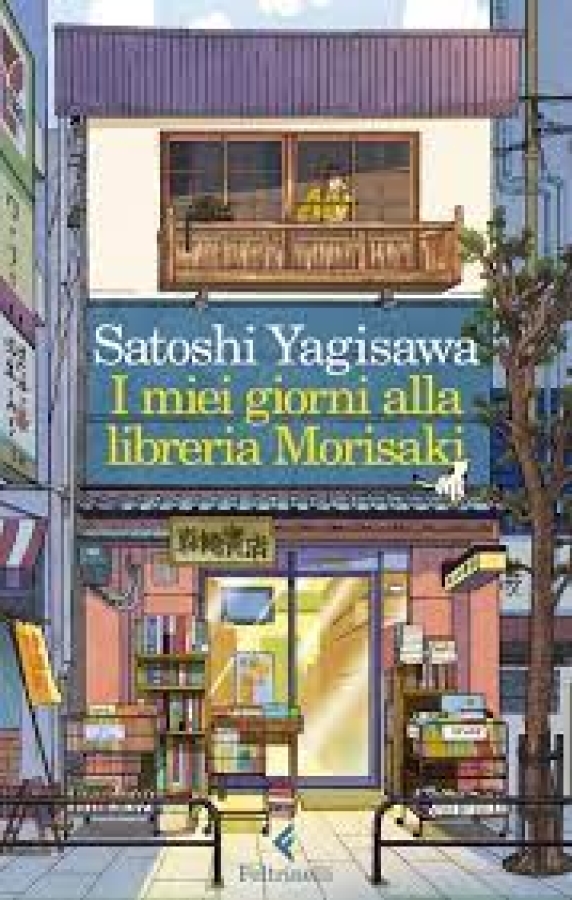
Finished reading on: July 10, 2022
Days at the Morisaki Bookshop
Title of the original version reviewed: «I miei giorni alla libreria Morisaki»
AI Translation Notice: This review was translated from the original Italian using artificial intelligence. Book quotes and excerpts are translated interpretations and will not match the author's original English phrasing or official published translations.
The impetus to read this short novel arises from the desire to understand why we read books, and consequently why we are so enthralled by the bookstore—that singular shop where paper volumes, large and small, yet always charming and inviting, rest upon the shelves. Who among us book lovers would not want to work in a bookstore! In this case, we are speaking of a secondhand bookshop, some volumes valuable, others commercial, in a Tokyo neighborhood where one sees nothing but bookstores on either side of the street. “A playground for book lovers,” murmurs Takako, the protagonist and narrator, after emerging from the subway station. She left a secure job after a disastrous love affair and has spent months shut away at home, sleeping all day. An uncle phoned her—an eccentric character who inherited her great-grandfather’s bookstore—proposing that she lend a hand running the shop, while also offering her a small lodging, crammed with books, dusty, with an overpowering smell of mold: a perfect den for a depressed soul like Takako. There is the risk that daily life will not truly change; after a few hours in the bookstore, she can slip back under the covers to sleep. But there are the books.
Those old books concealed stories unimaginable to me. And I do not refer only to what they recounted. In each one I found traces of the past
. In particular, the young woman was struck by a sentence by Kajii Motojiro (a Japanese writer who lived in the first half of the twentieth century):
what does it mean to look? It means transferring onto an object part of our soul, if not its entirety
. It is an evident Shinto approach, typical of Japanese culture, which reveals our relationship with the book: in reading, one feels an affinity with the writer and at the same time understands oneself better, in a mysterious involvement nourished by the words as well as by the scent and touch of ink and paper. The book is like a tree, like flowers and their insects, like animals, a landscape, a work of art: it is something that speaks through physical signs. Soon, however, Takako perceives the limits of the book.
In the bookstore I had found warmth and serenity, but I could not settle for that, or I would never have grown. I would have remained fragile. I had to leave, to take back the reins of my existence
. We are at page 59; up to this point, the story is intriguing: from here on, it slips into a banal, saccharine tale of a girl in search of herself.
To be sure, it would have been an exaggeration to expect a book on literature like Azar Nafisi's (Reading Lolita in Tehran, see the review on this site); we would have settled for Sosuke Natsukawa's The Cat Who Saved Books (see the review on this site), a verbose and at times banal tale, yet captivating in its hazy, mysterious atmosphere. Treating our indecipherable bond with books and the bookstore as the author has done stirs in us both disappointment and indignation.
Why not read it? It is superficial.