Finished reading on: March 03, 2019
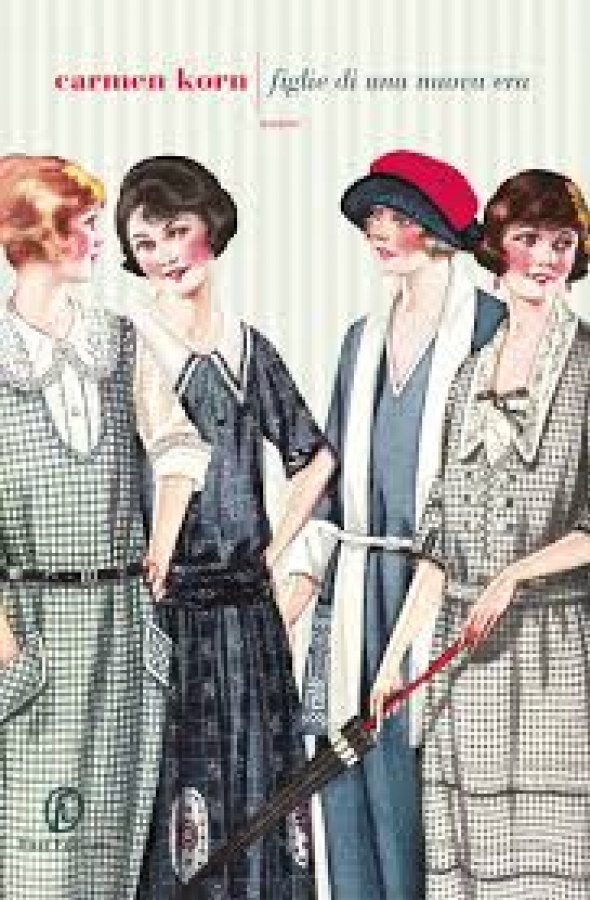
Daughters of a New Era
Title of the original version reviewed: «Figlie di una nuova era»
AI Translation Notice: This review was translated from the original Italian using artificial intelligence. Book quotes and excerpts are translated interpretations and will not match the author's original English phrasing or official published translations.
Rudi, the naive and dreamy husband of Kathe, one of the protagonists, encapsulates the novel's overall meaning in a poem:
against the light I saw/that the bridge has fallen/and the faint light/I have now lost/and I surrender myself/to the current that carries me
. Four young women are lifelong friends; they fall in love, marry, some of them become mothers, are widowed or divorced—in short, they lead an apparently normal life in Germany between 1919 and 1945. They live through the economic and social crisis of the post-WWI era, hyperinflation, the political turmoil of the Weimar Republic (with the suppression of the Communists by the Social Democrats), the rise of Nazism, racial purity laws (with the reporting of infants born with deformities), the gradual yet inexorable marginalization of the Jews leading up to the Shoah, and the catastrophe of the Second World War. How is it possible to lead a normal life in the face of such dramatic events?
But what was left to do now, if not retreat into the private sphere? The world was no longer an enchanting place
. (thinks Bunge, the spendthrift father of Ida, another protagonist). And indeed, the novel develops the stories of Henny, Kathe, Lina, and Ida from a deeply intimist perspective, only superficially grazed by the horrific events that affected the German people. Henny and Kathe have been friends since childhood and mutually decide to pursue careers as midwives, bringing children into the world precisely when one knows not what to expect from the future (a metaphor?). While Henny pursues the idea of family, Kathe makes different choices. The former marries young after becoming pregnant, has a daughter, loses her husband, and marries another, with whom she has another child, only to discover that her second husband was an informant for the Nazis; Kathe does not want children, is a communist, and urges her husband to become politically active, thereby upending both their lives. Ida, on the other hand, was born and raised in luxury; her father, on the brink of bankruptcy, marries her off to a wealthy and powerful banker, condemning her to unhappiness that is only partially redeemed by a long love affair with a handsome Chinese man. Lina soon discovers she is a lesbian and moves in with her partner, in a situation that grows increasingly precarious because homosexuality is condemned by the Nazi regime. There are many other characters, but even from this brief overview of the protagonists one can deduce the fragility of the entire narrative. It is true that war intrudes upon peace and that people strive to the very end to live in indifference; one does not expect War and Peace, but one might have expected a plot and character analysis capable of capturing the deep wounds of the human soul when confronted with danger and horror. Peace awaiting war creates a kind of suspension, and people cling desperately to the private sphere, to pale sentiments, customs, friendships, and familial affection. Two splendid novels immediately come to mind: Alba de Céspedes's There's No Turning Back, with its young women secluded yet sheltered within a boarding school, and The Makioka Sisters by the Japanese writer Tanizaki, a work in which the minute depiction of a 1930s Japanese family serves as a critique of inert familism and, at the same time, of aggressive, warmongering imperialism, so distant from the common sentiment of the people. There is none of this in our novel, so much so that Germany's dramatic events seem merely an excuse to inject some vigor into a plot that would be far too flat and mundane if set in a context of normalcy. It is the beginning of a trilogy, which we leave to other readers.
The narrative structure and the writing also warrant a negative verdict. The four young women's stories are developed in parallel through brief paragraphs within a chronological chapter framework. Consequently, the narrative is muddled, making it difficult for the reader to grasp the overarching story, and the plot ultimately proves verbose and repetitive. Too many characters contribute to compromising overall clarity. The writing, in turn, is flat, reliant on short sentences and dialogue; descriptions of the setting (Hamburg) and the social and political context are sorely lacking.
Why avoid reading it? Pointless, poorly written, and distasteful, considering what happened in Germany between the two wars.