Finished reading on: October 14, 2018
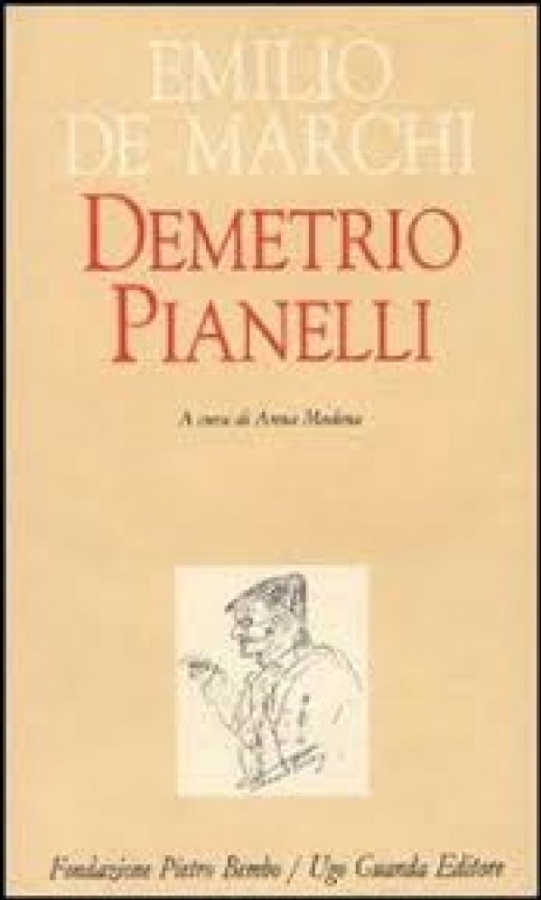
Demetrio Pianelli
AI Translation Notice: This review was translated from the original Italian using artificial intelligence. Book quotes and excerpts are translated interpretations and will not match the author's original English phrasing or official published translations.
The novel is set in Milan at the end of the nineteenth century: a city with its
broad straight avenues and luxury shops, (...) the movement of the trams and the bustle of busy people, intent on making money, working, producing, paying little heed to idle chatter, enjoying life without fuss or fancy
; in the background of human affairs a great clamor prevails, and yet not so far away lies the serene countryside, even the sight of Monte Rosa.
What can a poor devil do in a city
more good than bad, which willingly feeds those who work, but where (...) he who knows not how to dissemble knows not how to rule
? Demetrio Pianelli is a petty clerk, with “a low forehead covered with hair,” who leads a life paced by ironclad habits and modest joys.
Here is how De Marchi describes Pianelli’s arrival at his workplace.
He opened the drawer and checked the two rolls in their paper wrapper.
He gave a quick inspection to his round hat, (...) and placed it inside its little dust cover on the hanger.
Then he opened another drawer and drew out the two oversleeves of glazed cloth that he wore for writing.
He slipped them on: gave his hands a nervous, brisk rub, closing his eyes, crumpling every wrinkle on his face
.
The three small rooms where he lives have a little terrace, from which Pianelli can admire the flowers, and even more “the grasses, the simple weeds, clad only in green”; and when he wishes to take a breath of fresh air, it suffices for him to go for a stroll,
a few miles outside Porta Romana, (...) the classic land of greenery, of water meadows, of emerald pastures, long, wide, stretching as far as the eye can see, nestled deep among the rows of gray willows and trembling poplars
.
This man’s life is overturned by the suicide of his younger brother, Cesarino, known as Lord Cosmetico: handsome and elegant, he enjoyed life, and his young wife (nicknamed “the Beautiful Bigot”), lived beyond his means, ran into heavy debt, and, unable to face dishonor and imprisonment, chose to take his own life, entrusting Demetrio with his wife and three children—two young boys and a girl.
At first, Demetrio refuses to shoulder the burden of his brother’s family and settle his debts; later, under the pleading of his niece, he agrees to rush to their aid.
Demetrio (...) felt beneath the hardened rock, flowing like a river, a deep emotion seeking a way out.
(...) Demetrio curled up in his sullenness like a dry leaf.
The nerves of his face twitched beneath the hard bark.
(...) Why should I not have the will to help you? Ah, well then, (...) I too have known poverty and know what it tastes like: but against poverty there is only one remedy: the will to work and thrift, thrift and the will to work
.
Poor Demetrio! He thinks it is that simple, that it is enough to be a hard worker and an earnest man to be appreciated and to win—why not?—even the affection of his beautiful sister-in-law, thus building the family he never had.
It takes far more than that! A solid financial standing is required, like that of the landowner cousin—he, indeed, can aspire to the “Beautiful Bigot.”
Is Demetrio, then, one of the defeated? When he learns that his head of office, the powerful Cavalier Balzalotti, has attempted to seduce his sister-in-law, Demetrio rebels against hierarchy, against the secure job, against his fate as a wretched petty clerk, and shouts his utter contempt at the scoundrel before his flabbergasted colleagues.
People who judge in broad strokes might believe that the others had won, that is, the powerful and the scoundrels
, yet even against the author’s intentions, we believe that an honest gentleman has won.
For most critics, the novel’s theme is resignation, reminiscent of Manzoni.
In a petty-bourgeois, hypocritical context, watchful of pennies and property, steeped in a bigoted and superstitious religiosity, those at the bottom of the social ladder have no choice but to surrender, scraping by in their own quiet corner.
Outside the “shell,” out in the world, there is room only for those who know the art of living, which
consists, it seems, in taking things as God sends them and letting them go as the Devil takes them
(according to the wisdom of Cavalier Balzalotti).
And so it is that the novel’s various characters move, to the point of appearing as stereotypes, even caricatures, varnished with subtle irony.
Yet this is not the case for Demetrio: true, he is a curmudgeon, “an object out of use,” yet for that very reason he embodies a stubborn and indomitable courage, a detachment from the noisy, futile clamor; in this way, he conveys to us a message of “resistance,” despite it all.
The distinctive feature of De Marchi’s narrative style is irony, nurtured by idioms and turns of phrase drawn from the Lombard tongue.
In this way, the writer breaks radically with Manzoni; he contaminates standard Italian and brings us back down to earth, into the spoken language.
It is, unfortunately, a folkloric use of dialect, one that foreshadows what would come much later, in the second half of the twentieth century; one need only think of Camilleri and De Cataldo.
De Marchi, however, is timid; he lacks the courage to go all the way, and dialect remains an affected device, an end in itself.
Why read it? A delightfully depicted petty-bourgeois Milan, a humble and unwitting hero.