Sladana Nina Perkovic
Books by this author (1)
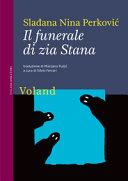
The Funeral of Aunt Stana
“If this were, for instance, a Hemingway story, by the second paragraph its protagonist would already be shooting fascists, (...) a nurse would have fallen in love with him (...). Naturally, she would be a woman so wonderful and caring that she would die along with the baby during childbirth, if only to save him from the monotony of family life. (...) However, I am not Hemingway. Looking at things realistically, for the most part I am merely an extra in my own story.” The narrator—such a nonentity that we are not even told her name—is a young woman who spends her time glued to the TV, binge-watching her beloved shows. How do the Japanese manage to barricade themselves inside; don’t they have mothers? And hers forces our protagonist to abandon her cozy, protective den to attend the funeral of Aunt Stana, who choked to death on a chicken bone. She finds herself thrust into ancestral, corroded family ties in the village of her childhood, where adolescent dynamics—long repressed or simply buried in the deepest recesses of the soul—resurface. The narrative is caustically ironic and yet so violent that it repeatedly forces the narrator to pause “and take a breath of fresh air.” The relatives are extreme figures, caricatures of the archetypes found in every family: the overbearing and the submissive personalities, the mutual hatred and contempt calcified over decades, the rote repetition of habits and gestures, the vulgar greed over a prospective inheritance. And at the center of it all is she, the narrator, invisible, just as when “the bus drivers would drive right past me without stopping, even when I stood in the middle of the station, even waving my hand at them.” Events rapidly escalate. A torrential downpour sweeps everything away, dragging our protagonist into a ditch of mud where she might finally rot in peace; though, knowing her luck, archaeological excavations will likely exhume her centuries later: “there’s simply no way people will ever leave you in peace!” That is, until a stroke of fortune lands her a thick roll of euros hidden inside an overcoat. “At that moment, a brilliant idea flashed through my mind. I’d love to tell you all about it in detail, but unfortunately I don’t have the time. The hill above me is about to vanish in a terrible explosion, and right now I don’t much feel like sticking around for the show. I have to leave at once. If I don't hurry, everything could easily turn to dust.” The novel is set in Bosnia, yet the backdrop could easily be Japan, Italy, or anywhere else in the world. Both the allure and the limitation of many Eastern European writers lie in the universality of their stories. As in László Krasznahorkai’s *The Melancholy of Resistance* and Elvira Mujčić’s *La buona condotta* (see the reviews on this site), here too the author operates within an ahistorical, surreal, and Kafkaesque dimension. If, on the one hand, the reader sees themselves reflected in the narrative (who among us hasn't attended a funeral among complete strangers for relatives?), on the other, one fails to sense the tragedy of a nation like Bosnia and Herzegovina—torn for years by religious, linguistic, and national divides, perpetually teetering on the brink of civil war. Or is this an escape from a harsh, harrowing reality that frees the writer to tell extraordinary tales, as the author suggests in the afterword? From a narrative standpoint, the prose flows smoothly within a well-constructed plot, even if it ultimately grows repetitive and predictable. While it is true that the narrator is merely an “extra,” the story becomes far more compelling precisely when she steps forward, offering evocative windows into her life and oneiric departures—glimpses into her personality that are all too brief. Why read it? For its biting, surreal dissection of the family unit.