Sides Hampton
Books by this author (1)
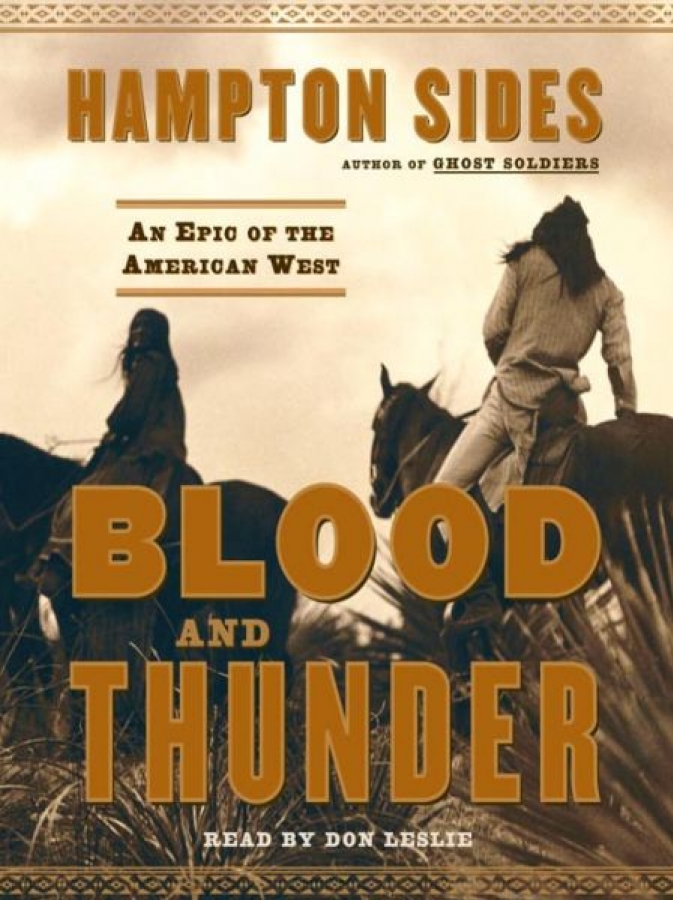
Blood and Thunder
The book’s subtitle is “the epic story of Kit Carson and the conquest of the West.” Indeed, the book spans a very long period, from 1809, the year of Kit Carson’s birth, to his death in 1868. Even though the great scout lies at the heart of the book, in reality it features all the protagonists of those years who contributed to an exceedingly complex and multifaceted history, shaped by competing ambitions: the imperial dream of the United States aimed at conquering the entire continent from East to West at the expense of a weaker nation, Mexico; economic expansion toward territories whose wealth was often overstated; the American Civil War and the role played by Indigenous nations; the clash of cultures (North Americans, Mexicans, and Indians); and, finally, the heavy imprint of a Methodist vision intent on imposing its own rules without acknowledging particularities and cultural distinctions. At the core of the book, therefore, lies the American dream: the conviction of being inherently in the right, and consequently the inability to understand the indigenous peoples. The latter, accustomed to a nomadic society rooted in raiding, fail to realize that they are up against a new adversary—one quite different from the Spanish and the Mexicans, equipped with technological superiority and, above all, an obstinacy driven to see matters through to the bitter end. It is the Navajos who pay the heaviest price, despite having been one of the strongest and wealthiest Indian nations. They are destroyed: first by starvation, then by the long march toward a settlement intended to serve as an experiment in civilization, which proves instead to be an inhospitable wasteland where disease, poor harvests, and contaminated water deal a mortal blow to the Navajos. It is a chronicle of clashes and battles, of plunder and cruelty, laying bare a violent society on both sides. A curious code of conduct effectively binds Americans and Indians alike: an eye for an eye, a tooth for a tooth. In this context, Kit Carson—already a legend in his own lifetime—stands as an emblematic figure: a consummate scout gifted with both diplomatic and martial prowess, a commander, yet ultimately an executor who, against his own inclinations, is compelled by obedience and gratitude toward others to wage wars and endure conditions he does not himself condone. Deep down, he is frail, a weakness evident in his physique and his voice to such a degree that visitors who had read accounts of his life and exploits failed to recognize him when meeting him in person. He is a hero who becomes one in spite of himself, almost an artfully crafted figure within the American collective imagination. This persona served to open the conquest of the West to the American people and to rationalize the slaughter of the Indians. Like all heroes, he is also an antihero. The book is a compelling work. It appears historically well-documented, and while not a novel in the strict sense, the narrative possesses all its hallmarks. The overlapping of episodes, which develop in parallel before converging into a central storyline, likewise generates an atmosphere of suspense typical of a detective story or contemporary fiction. The approach is cinematic. Its most compelling aspect is the extensive reliance on the very diaries of those who took part in the events. For instance, a woman who followed the wagon train toward the conquest of Santa Fe, the capital of New Mexico, writes with scandalized outrage about a ball held in honor of the conquerors, where Mexican women appeared in low-cut, provocative gowns.