Renata Viganò
Books by this author (1)
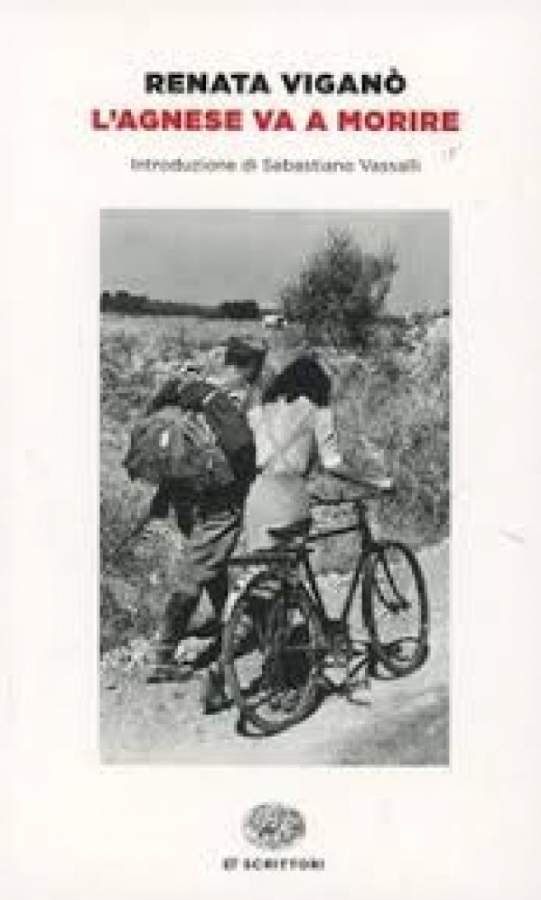
Agnese Goes to Her Death
The novel chronicles the Resistance in the Valli di Comacchio, between the mainland and the wetlands. Unlike the great works on the war of liberation (1943–1945), typically set in the mountains, *LʼAgnese va a morire* tells of the lowland partisan war, where > the Germans did not know that among those men and women, wandering through the snow, many, almost all of them, were partisans. Couriers dispatched with orders hidden in their shoes, leaders heading to meetings in peasant barns, commanders preparing actions where no one expected them. (...) A fire without flame or smoke: a markless fire. The Germans and the fascists walked right over it, noticing only when they were burned. The lowlands, and in particular the marshland environment, form the backdrop to Agnese’s story: a fat, old woman, who until then had been an industrious washerwoman and a rough peasant. > One September evening, Agnese, returning home from the washhouse with a heap of wet laundry on her wheelbarrow, met a soldier on the cart path. (...) His shoes were torn, and his toes could be seen, dirty, the color of mud . Without hesitation, Agnese gives him shelter and later shows him the escape route when the Germans arrive. With this seemingly obvious act, Agnese embarks on a human and political journey that takes her from > a mature, composed yet ruthless hatred towards the Germans, (...) towards the subservient fascists , to becoming > truly responsible for incomprehensible actions and unforeseen decisions . At first, she is asked to carry a parcel and she replies: “if I’m capable”; then she becomes the coordinator of the couriers while securing a safe hideout for the brigade command; finally, she is forced to make solitary, swift, and perilous choices involving the lives of many partisans. All this would remain an abstract tale were it not admirably embedded in the marshland setting and in the conditions of struggle and survival that defined it. Across the seasons, from spring to winter, living conditions grow increasingly harsh, mirrored by an escalating clash between partisans and Germans. > They moved by boat through the green canal, slimy as a slug. On either side the reeds stood tall, yet cast no shade: the sun pierced through the straight, bare stalks as if through an iron grating, burning on the water, on the floating weeds that resembled dead grass snakes. (...) It is a magnificent place, the Commander said, the reeds provide neither greenery nor shade, but they conceal. (...) Agnese knew that sound of the marsh at night: a dull hum, an isolated cry . The partisan detachment has taken refuge in an isolated hut in the wetlands, and here > toward evening they would sing, their voices low so that no one might hear them, and their song would seem little more than the rustling of the reeds... (...) The couriers brought bread, wine, orders, and circulars to the camp... . With winter and the mounting pressure from the Germans, > away, away from the house, away from the prison, prisoners still of that dark, roiled water, choked with weeds and mud, yet already bound for land, where one could breathe one's own air, clean air, not just the breath of the comrade beside you, and where one walked not across a few feet of flooring, but forward, along a road, an embankment, a field, forward toward the world of free men . Hemmed in between the Germans and the Allies, fleeing a hostile and intolerable environment, the partisans go to die, > if only to reach the shore, to be out of the water, to set foot upon ground that did not shake . Agnese dreams of her husband, who died during deportation to Germany: > It’s hard, isn’t it? I know you can’t take any more. But it isn’t time to let go yet, Agnese. (...) Agnese saw him open the door to the cold of the staircase, truly felt that wave of cold against her face. Then she realized it wasn’t Palita (her husband), and behind him was another, and another, and another. The last one quietly closed the door. After so many men as protagonists of the Resistance, here at last is a woman, and certainly not an intellectual! If only for doing justice to women’s contribution to the partisan struggle, the novel deserves a prominent place in the literature of the war of liberation. Yet one must not be confined by this single interpretive lens: the novel contains numerous characters, countless episodes of civilian and combatant life, and an intense narrative pace punctuated by dramatic twists, not least the final one. Criticism has regarded it as a neorealist novel; yet if one allows oneself to be captivated by the writing, particularly the descriptions of the marshland environment, it becomes evident that the narrative possesses a lyrical, even oneiric undertone. One might think of it as a dreamed epic, a modern *Iliad*, dense with myth and heroic figures: precisely what we need. The style is lean, marked by an adroit use of punctuation: the short, concise sentences do not fragment the narrative, but rather lend it communicative power, bolstered as they are by a richness of adjectives and the use of brief, succinct dialogue. Why read it? A masterpiece of substance and style!