Emanuel Carrère
Books by this author (1)
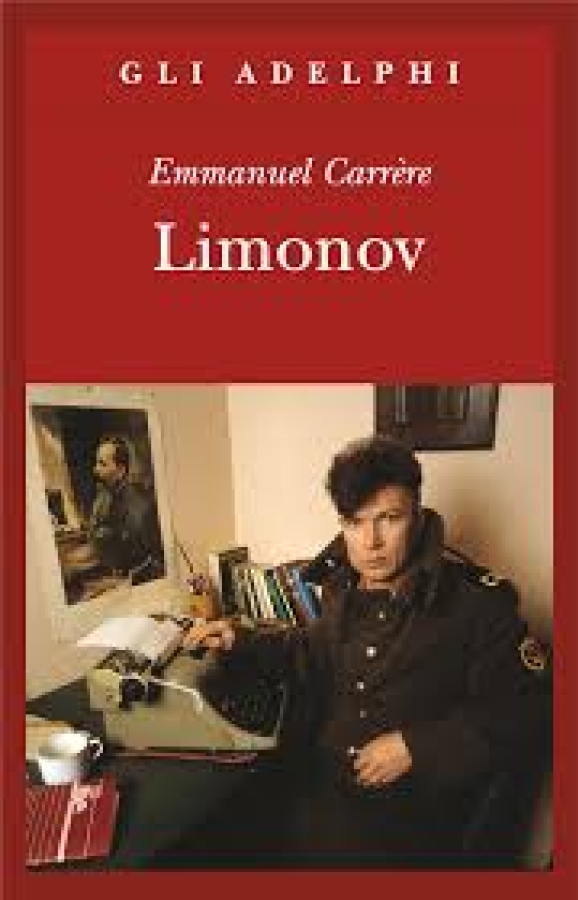
Limonov
In *Diary of a Failure* (2004), Eduard Limonov imagines that > they will all come. The delinquents and the shy (...). The drug dealers and the procurers for brothels. The onanists will come, the lovers of porn magazines and films. (...) The pensioners will come, those who queue at the supermarket in the express lane for customers buying fewer than five items. (...) They will all come, take up arms, occupy one city after another, destroy the banks, the factories, the offices, the publishing houses, and I, Eduard Limonov, will march at the head of the column, and everyone will recognize me and love me. This passage, quoted by Carrère, aptly captures who Limonov (1943–2020) was; this Russian D'Annunzio who moved through the second half of the twentieth century like a superman, seeking not to build anything (be it literature or a political party), but pursuing action solely for action's sake, outside of every framework, driven by an ideal of narcissistic aestheticism. For Carrère, Limonov is what he himself never dared to be (as the writer's sister described him as a boy: > my brother is very serious, he never does foolish things, he reads grown-up books all day long ), and so, to live a little like a superman, Carrère writes a “real” novel that suffers from the major flaw of drawing fundamentally from the character's own autobiographical accounts. And it is fortunate for us readers that the entire narrative is filtered through the halo of imagination. From the very beginning, when Carrère meets him in 2007—a sixty-five-year-old engaged alongside Kasparov in a liberal-democratic movement—Limonov appears an exceptional figure in the eyes of the French intellectual: > he is still lean: flat stomach, adolescent build, smooth and tanned Mongol skin, (...) something of the aging d'Artagnan of *Twenty Years After* (...). Or is he, the bandit, the rogue, amusing himself playing the role of the virtuous democrat...? (...) Deep down, does he relish playing the wolf in the sheepfold?.Carrère lightly retraces the entire life of our protagonist: the myth of the father, an officer in the glorious Soviet army, later shattered by the family's downward social mobility; the wild adolescent, always with a heavy knife in his pocket, yet a young poet nonetheless; the stay in Moscow during the height of the Brezhnev era among intellectuals passively chafing under the regime; and then New York and Paris, where he succeeds in publishing his American novels; and once again the return to Moscow, his association with Aleksandr Dugin, Putin's alleged ideologue, and together they found the National Bolshevik Party, which lands him in prison, from which he emerges triumphant. Bisexual, ever surrounded by gorgeous, sensual women, shifting between scenes of uninhibited sex and subtle intellectual conversations, not without his share of crimes and violence in the former Yugoslavia (after all, D'Annunzio too knew “regenerative” war), Limonov's life unfolds without remorse, like that of a true superman; or is it merely what the trickster Eduard wished to tell us, and the naive intellectual swallowed whole? Whatever Carrère’s intentions may have been, one must wonder why he did not devise an original story, the fruit of his own creativity, choosing instead to chronicle a real-life figure. This approach suffers from two principal shortcomings. First, one falls prey to the self-representation offered by Limonov himself, creating a sort of distorted lens that ultimately exalts such extreme figures—figures the media industry adores because they are simultaneously harmless and magnificent. Second, the narrative follows an uneven course: sharp and incisive when drawing upon Limonov's own novels (the years up to Paris and his imprisonment), only to flatten out into mere chronicle when forced to rely on other sources. It is no coincidence that the dialogues are concentrated where Limonov's autobiographies are used, and it is precisely in those sections that the narrative becomes most vivid. Assuming Carrère wished to depict the decline of Europe and the United States along with the root causes of the rise of Putin and sovereignist movements, why not do so through historical analysis grounded in established methodologies, or set himself a more ambitious goal: to be a new Hugo or Dostoevsky capable of true literature? In our minds, Limonov will forever remain trapped within his own era, never achieving the universality and eternity of Jean Valjean in *Les Misérables* or the characters of *The Brothers Karamazov*. The novel's merit lies in its narrative style—elegant and subtly ironic. Well-constructed, if overburdened with names, the reading flows pleasantly, particularly in the first part, which is undoubtedly the finest from a narrative standpoint. The tension begins to flag during the Parisian period, marred by a certain characteristically French complacency, before declining steadily to the point of inducing a distinct impatience. Why read it? Well-written, and an interesting depiction of the decline of Europe.