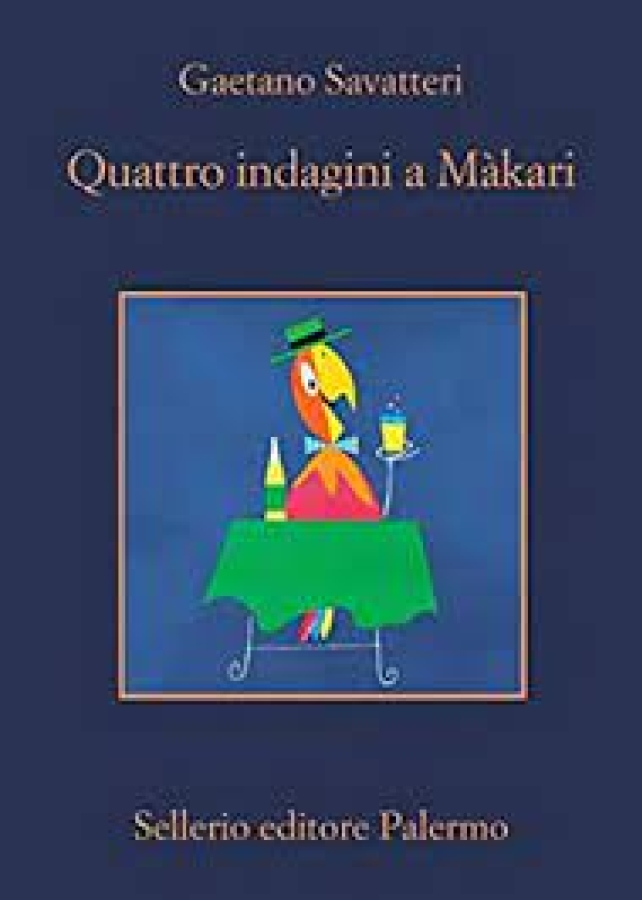
Four Investigations in Màkari
Saverio Lamanna was the spokesperson for a prominent politician and was brutally dismissed after drafting a press release stating that his boss supported the liberalization of cannabis. Was it an error, or did Saverio simply wish to walk away from a job he no longer enjoyed? We do not know; at any rate, he was forced to leave Rome and return to Sicily, moving into his parents' house in the small, quiet village of Màkari, near the more renowned resort of San Vito Lo Capo. It is the house where he spent his childhood, deeply cherished by his mother, who had passed away some years prior. The book consists of four short stories, previously published by Sellerio in earlier collections; brief tales bound by the same common thread: «we often look for the big game, but sometimes the game is small». When set against our conventional view of Sicily, where everything is traced back to the Mafia, Saverio introduces us to an island far closer to home than we might suppose. It is the same approach adopted by other Sicilian authors, such as Andrea Camilleri and Cristina Cassar Scalia (see the review of *Sabbia nera* on this site). One might wonder whether this pursuit of ordinary crimes does not end up diverting attention from the fight against the Mafia, understandable though the weariness with stereotypes and crude readings of Sicily may be. In the first story, *Il lato fragile*, a prominent figure in the war against the Mafia is killed by a boy, a fragile youth under the care of a priest who is likewise an adversary of Mafia society. It might appear to be a Mafia-related hit or a sexually motivated crime. Could that be true? In *Il fatto viene dopo*, a friend of Saverio's has been fired from the firm where he had worked for many years; he asks Saverio, who has in the meantime become a celebrated author, if he would tell his sad tale: > there is still someone who believes in books, right now when they are of virtually no use anymore . But crafting literature is one thing, and real life—where events can take a turn for the worse—is quite another. In the third story (*La regola dello svantaggio*), Saverio's house has been leased for the summer without his knowledge: he intends to file a police report, but the shrewd real estate agent reminds him that it is better not to play the disadvantage rule, just as in football when play is waved on after a foul. Saverio would have to explain why he accepted under-the-table cash, the French tourists would have to testify and be left with a sour memory of their Sicilian holiday, and the island's tourism would suffer were the fraud to come to light: far better to do nothing, «so that everyone is happy». Alongside this quintessentially Italian affair, Saverio discovers that an elderly, wealthy gentleman did not die of natural causes, but was murdered with an overdose of insulin: was it the son, or the attractive young wife? The title of the final novella (*È solo un gioco*) could easily be turned into a question, for behind an innocuous football team lurks a murky secret that may well lead to murder. Savatteri is an incisive and ironic writer. Crime serves merely as an occasion to discourse lightly on Italy, without taking oneself too seriously and without any illusion of changing anything. The characters are very well drawn, and the Sicilian setting (Palermo, Màkari and its beach, the island's mythical cuisine) is depicted with charm; yet there is perhaps too much dialogue, often repetitive and tedious. The fundamental flaw is the total absence of suspense and mystery—the core ingredients of any compelling noir. Why not read these stories? Tedious, overlong, and devoid of suspense, albeit amusing at times.

A Matter of Constancy
Costanza is a single mother from Messina with a degree in medicine and a specialization in anatomical pathology. Unemployed, she wins a competition for a one-year research fellowship at the University of Verona in paleopathology. > Utterly ignorant of everything concerning the Holy Roman Empire, the *Signorie*, and pre-Columbian mummies, (...) the truth is that I am interested in this grant neither more nor less than as an ATM . The novel presents itself as a historical mystery, very much in vogue today: archival and laboratory research carried out on human remains from the 1200s belonging to a high-ranking knight. In reality, there are three narrative strands that coexist uneasily. The dominant plotline concerns the experiences of a young mother: settling her daughter into a nursery school in Verona, her guilt toward the child—born of a casual encounter and forced to grow up without a father figure—and the search for the father (a wealthy Milanese architect) who, once tracked down, rekindles Costanza’s desires. It is a banal tale sustained by juvenile writing: it escapes monotonous ordinariness only when Costanza speaks of her erotic dreams, > which cannot be told to anyone, not even to one of those psychotherapists obsessed with the unconscious mind’s subliminal messages . A little courage, please! Dear Costanza, do not merely tell us that upon waking you are confused and bewildered; in any case, we shall turn to Patrizia Valduga: > in this cursed dark night/I was assailed by a temptation/whose shame still lingers in my heart./I, so modest, so proper,/saw a man come softly toward me/and embrace my waist almost greedily;/another came, and with his hand/oh delicately he opened me;... (From *La Tentazione*, 1985). The second narrative strand is more strictly a detective story. Starting from locks of red hair, Costanza and her colleagues trace their way back to Biancofiore, daughter of Frederick II, who lived in a French monastery where she purportedly extracted a perfume from roses, traces of which were identified in the human remains found in Verona. How did a princess of imperial rank—normally destined to be wed into houses advantageous for alliances—end up in a convent? The author imagines that Biancofiore was lame, and therefore useless for matrimonial purposes, and that she had furthermore fallen in love with a Guelph knight who betrayed Frederick II and was subsequently murdered. With the third narrative strand, we move to the 1200s, to the court of the Emperor and then to that of the Lord of Verona: the cruel Ezzelino. First, there is Selvaggia, a natural daughter of Frederick II, given in marriage to Ezzelino, who supposedly murdered her according to legend—though in reality, she died in childbirth. Then unfolds the sorrowful tale of Biancofiore, ultimately the protagonist of the detective plot. How do these three narrative strands come together? It is difficult to say. Straining one’s imagination, one might say that Selvaggia and Biancofiore bear a slight resemblance to Costanza; still in love with her daughter’s rediscovered father, she too must accept that he is marrying another woman. Together, the three young women can do nothing but resign themselves to fate, accepting it: > I will show no disappointment, I will show no disappointment. I will show no disappointment. (...) But inside I feel liquefied. My hidden hopes, liquefied. The small, great, draining infatuation, liquefied . The writing is far too puerile to support a plotless story, which would require an articulated style capable of lending depth to the characters and context. Why not read it? It is simply too banal.