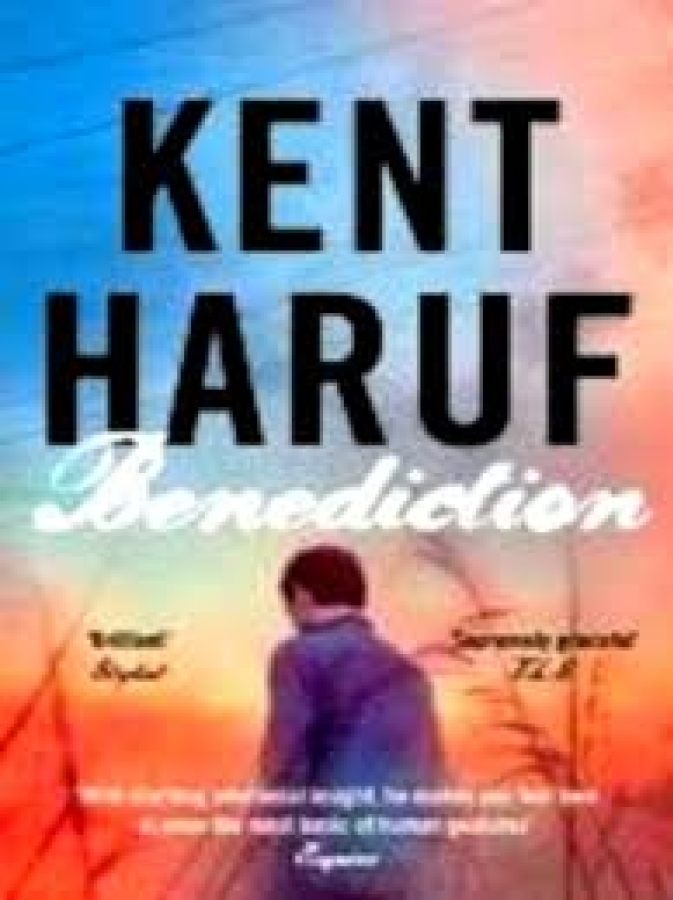
Benediction
Dad Lewis and his wife return from Denver > away from the mountains, back out onto the high plains: in the pastures an expanse of buffalo grass, sagebrush, weeds, and blue grama, in the cultivated fields wheat and cotton. On either side of the highway there were dirt country roads running in all directions under a pure blue sky. Holt is a small Colorado town like so many others, a place hardly worth identifying because it is the same everywhere, it is where normal life is lived, > the precious ordinary life: mundane stories, with nothing exceptional about them, stories that could belong to anyone, yet which hold within them love, familial affection, unhappiness, guilt, memories, and the expectation of Death. Dad has just learned he has only a few months left to live, due to lung cancer. We witness the man’s slow, inexorable physical decline. Through frequent flashbacks, the author offers glimpses of what now torments Dad. In the past, as the owner of a supermarket, he fired an employee who had stolen from him; Dad was unrelenting, cast from a single mold, offering no second chances—not even to the man’s wife, who had gone so far as to offer her own body to pay back what had been taken. The man killed himself, leaving his family in destitution. This unyielding attitude led to a rupture with his son. When he caught him, still an adolescent, wearing his older sister’s clothes, he beat him, terrified of scandal and rejecting his homosexuality; the boy ran away from home, leaving no trace behind. With his elder daughter as well, who has returned home to care for him, he was emotionally detached, stern, and distant. Now, he realizes he has never caressed his daughter. > I was too busy. I didn't pay attention. No, she said, You weren't. She put her hand on his cheek, now. Forgive me, he whispered. I missed out on so much. I could have done better. I have always loved you. He wants to see his son again, he waits for him, he longs to reach out to the woman to apologize, he wishes he could turn back time, but now the people of his life, those he has lost, are merely part of a terminal patient’s nightmares. While Dad’s inexorable journey toward Death is the central narrative, other lives revolve around it, all marked by suffering. > Every life passes through some kind of unhappiness, (...) but there is good as well. (...) There are only brief moments. And as in Kader Abdolah's *The Parrot Flew Over the IJssel* (see review on this site), the cycle of the seasons rolls across the Great Plains. > In autumn the days turned cold and the leaves fell from the trees and in winter the wind came down from the mountains and out on the high plains of Holt County there were night storms and three-day blizzards. The novel demonstrates how our lives slip by without us seizing the opportunities to show humanity toward others, to comprehend the suffering of those around us. To be sure, Dad displayed great moral integrity in refusing the advances of an attractive woman; but wouldn't it have been better had he accepted them, had he been more forgiving of himself? Even in our prosaic lives, so far removed from those of great men, we are constantly faced with choices, and these decisions concern our relationships with others. At the end of life, nothing remains but remembrance, yet Death dissolves even that. > If one does not die, one lives, so writes Salvatore Satta in *The Day of Judgment* (see review on this site). > And this truth, seemingly obvious, is instead heavy with consequences, for life transforms everything; nothing can withstand its implacable truth. (...) To know oneself, one must live out one's life to the very end, to the moment one is lowered into the grave. The fundamental strength of the book lies in its prose: crisp, spare, and mesmerizing all at once. Short sentences, taut dialogue, and sparse digressions on the setting follow in succession; the characters are not merely described, but reveal themselves, always wrapped in that aura of mystery, of the incomprehensible, that shadows us throughout our lives. If Dad reveals himself in Death, who are the others? It is a pity that the narrative rhythm, elsewhere so intense, is compromised by an ending of a melodramatic and frankly verbose register. Why read it? Splendid prose.
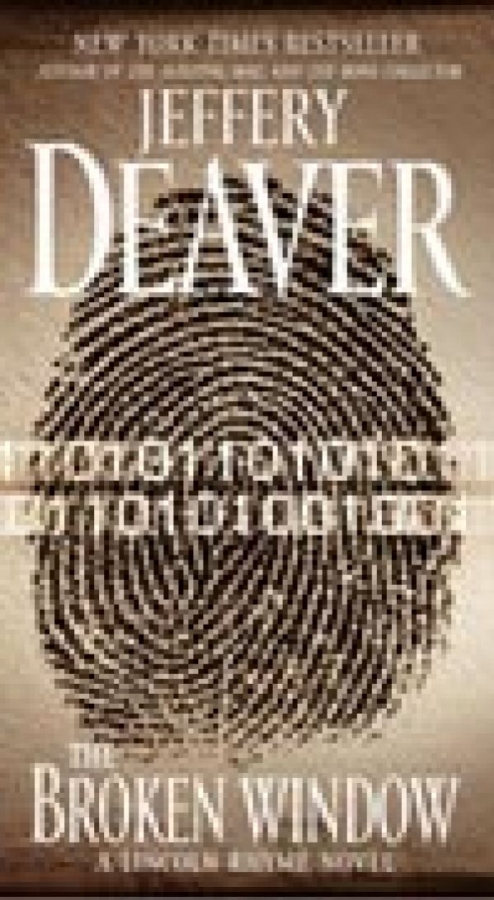
The Broken Window
Anyone who has read or seen *The Bone Collector* in the cinema is already familiar with the book's main characters. Lincoln Rhyme is a renowned criminologist who bases his investigative techniques on the rigorous and meticulous use of "physical" evidence, even the most insignificant. Despite having been left paralyzed following a shootout. Rhyme continues to collaborate with the police, assisted by a team of detectives and by Amelia Sachs, a close and capable collaborator as well as his life partner. Rhyme's cousin is accused of rape and murder. All the evidence points to his guilt. Rhyme is quickly convinced that the clues have been fabricated by a serial killer who "knows everything." In the course of the investigation, Rhyme and his team discover the existence of a massive private organization that collects, stores, and processes information on virtually everything, selling it to corporations (for market research, for instance) as well as to public and state institutions. It is a "Digital Big Brother," whose data is seemingly inaccessible, yet which the criminal has managed to exploit and even manipulate. The thriller is skillfully constructed, boasting a plot rich in twists and an unpredictable conclusion. The best part of the book is its depiction of the world of big data processing corporations. Rhyme’s team proves remarkably inexpert (perhaps excessively so, given they do not even know Excel) and ventures into this realm step by step, left stunned, fascinated, and alarmed. Rhyme himself is disconcerted: can access to such vast amounts of information truly supplant the method and intuition that must govern criminology? And the reader, too, begins to wonder. On the surface, possessing powerful databases and sophisticated data collection tools would appear to be a monumental achievement. But is it worth it if a criminal can exploit them to commit rape and murder with impunity? Is the availability of so much information—which even enables the prediction of events—truly helpful in tracking down killers, or do traditional, obsolete investigative methods remain more effective? The premise is intriguing, the prose concise and effective, the plot well-engineered, and the characters—especially Amelia Sachs—compelling; it is a pity that, as so often happens with thrillers, the novel's sheer length renders it wordy and meandering. Are these authors paid by word count, as Salgari once was? Why read it? It is a solid thriller, and the theme is compelling.