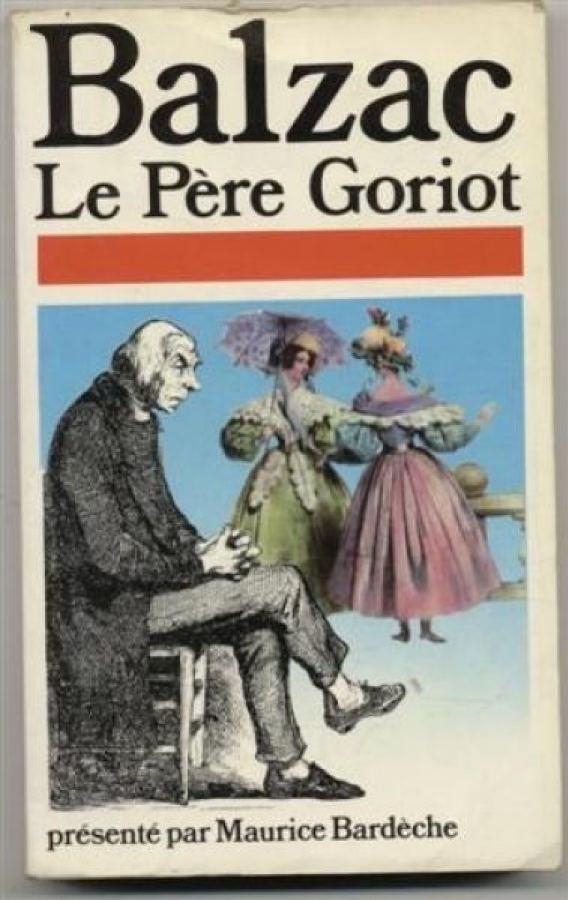
Father Goriot
Balzac lived in the first half of the nineteenth century and thus depicts the society of Louis-Philippe. The novel recounts the story of a man who, out of love for his daughters, leads a wretched and despised life. His paternal devotion stands in stark contrast to a society dominated by money, appearances, and climbing the social ladder at all costs. The approach is moralistic, the style tedious and ponderous, the French difficult: in short, a "bad" novel, which I could not bring myself to finish. When one compares Balzac (at least the Balzac of this book) with Stendhal, the disparity in quality is striking: where Stendhal is nimble yet profound in his characterizations (figures rich in contradictions), Balzac appears rigid, didactic, and predictable. In Stendhal there are "heroes"; in Balzac, opaque figures already condemned to an existence trapped within the constraints of money and social ambition. Perhaps Balzac’s society is truer to life, but it is undeniably duller. To say nothing of the French. In Stendhal it flows, and it is the very structure and rhythm of the sentence that endow the narrative with meaning (with no need for an excess of adjectives); in Balzac, an elaborate vocabulary is required merely to give expression to the tale.