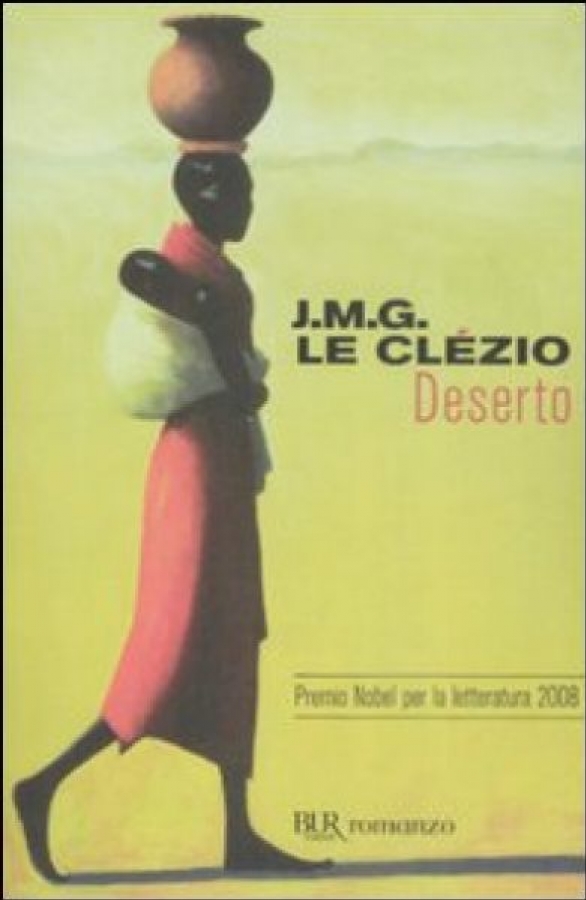
Desert
This is a book that develops along two narrative paths that are seemingly distinct, yet bound together by an ideal thread. On the one hand, it narrates the story of a desert people, followers of a sheikh revered as a saint, who intend to resist the French conquest of Saharan Africa. The desperate march of these people is seen through the eyes of a boy, who may well be the grandfather of Lalla, the novel’s protagonist. On the other hand, the novel chronicles the story of Lalla, born amid the scrub and taken in by her aunt in a small seaside village. Lalla lives a wild existence, in the wind and among the dunes, a lover of solitude and of the desert. During her long, solitary walks, she is accompanied by a shepherd, Hartani, a boy who does not speak her language but who possesses a profound understanding of nature, of birds, of flora, of the sea and the desert. Hartani belongs to the "blue men," the men of the desert, the very same people who took part in the grand and disastrous march recounted in the novel’s other thread. Lalla is meant to be wed to a wealthy merchant, and so she flees with Hartani toward the desert. The story then picks up with Lalla arriving aboard a small vessel in Marseille, seeking shelter with her aunt, who has relocated there. Lalla is pregnant, but hides her condition and leads a life just as wild in the great French city: yet what in the village had been light and symbiosis with all living beings turns, in Marseille, into darkness and loneliness. Lalla lives in a tenement hotel that houses scores of immigrants who come, out of desperation, to work in France. There she also meets a boy who survives by stealing and begging. Lalla has descended into the underworld, yet among the desperate she discovers a profound solidarity and support. By chance, she meets a photographer who turns her into a famous model; in the end, however, Lalla resolves to return to Africa and give birth to her child amid the dunes, in the coolness and sweetness of a tree’s shade. The true subject is the contrast between Western and North African civilization. This contrast is crystallized not so much in the characters—too stereotypical, devoid of depth and complexity—nor in the plot, virtually non-existent and in certain respects implausible (such as the episode of the photographer who makes Lalla famous), but rather in the landscapes and in the author’s ability to impart density and chromatic richness to the descriptions. Upon the sand dunes, "Lalla opens her eyes wide, lets the sky enter into her," and senses the presence of God: > where is the road? Lalla does not know where she is going, adrift, swept along by the desert wind that blows, vengeful and cruel, the wind that sweeps men away and brings down the rocks at the foot of the mountains. It is the wind that moves toward infinity, beyond the horizon, beyond the sky all the way to the cold constellations, the Milky Way, to the sun . If the desert is light, infinity, and bliss, the city is death. > Lalla watches those who depart for other cities, toward hunger, cold, misfortune, those who are going to be humiliated, who are going to live in solitude. They move toward dark cities, toward low skies, toward steam, toward the diseases that ravage the chest . Yet Lalla harbors a dream: it is the desert people’s dream of freedom, of living free in the sun and the wind. It is written in magnificent French, with a powerfully lyrical style, brimming with evocative resonance and musical cadence, succeeding in rendering through words the sensory impressions of a natural world and an environment. Beyond individual pages, however, this vision of a "virtuous" society set in opposition to Western civilization feels somewhat disingenuous—more an intellectual, aestheticizing posture than a genuine impulse to chronicle the true complexity and suffering of an oppressed, shattered, and migrant society. It is, in a sense, the Westerner’s quintessential search for the presumed purity of the Other.