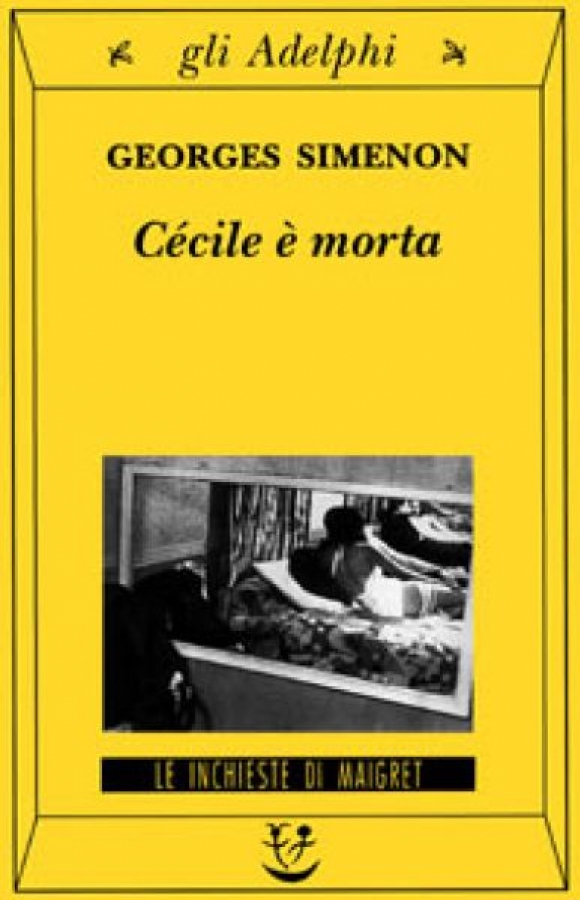
Cécile is Dead
This is likely not one of Simenon’s finest novels. The plot is exceedingly simple: the niece, who served as a maid, kills her sick aunt when the latter refuses to give her money for her brother. Rummaging through the drawers, she discovers old papers proving that the aunt, together with her lover, had murdered her husband fifteen years earlier. The aunt’s former lover, who remains her business partner and lives in an adjoining flat, in turn murders Cécile to prevent her from revealing the contents of the documents she uncovered. From the standpoint of the detective genre, the events of the novel feel predictable, and the pacing certainly fails to grip the reader. The atmosphere (the figure of Maigret, the petty-bourgeois life) is sketched in a hurried, almost superficial manner. The fundamental virtue of the novel lies in its style. Even if the French language is not simple (owing to the richness of its vocabulary), it becomes readily intelligible through the sequence of clauses and words, which, even phonetically, help convey the traits of the characters, Maigret’s demeanor, and the salient aspects of the setting. What is to be appreciated is not so much the novel as a whole, but rather certain glimpses, such as the following: > Il arrivait a Maigret de hausser les épaules quand on s’émerveillait devant lui de la résignation des humbles, des malades …..sans horizon…. ; il savait par expérience que la bete humaine s’accomode de n’importe quel nid, du moment qu’elle peut le remplir de sa chaleur, de son odeur, de ses habitudes .

The Count of Monte Cristo
The plot of the novel is well known. Edmond Dantès is wrongfully imprisoned. He manages to escape, becomes immensely wealthy, and consequently devotes his life to vengeance through a series of deceptions and acts of cruelty. The novel appears to have been inspired by a true story. It unfolds across three distinct levels: adventure, sustained only at times by a gripping pace, as in the first part (the imprisonment, the acquaintance with Abbé Faria, and the escape) and at certain subsequent moments. All too often, the novel develops in a slow and tedious manner, even in the face of surprises and plot twists; the setting, which emerges from the description of Rome, of the island of Monte Cristo itself, and of Parisian society. In some instances, it is an effective, if somewhat mannered, fresco (as in the case of Rome); in others, one is confronted with a superficial and hurried description; the superhero, embodied in the figure of the Count of Monte Cristo—a hero who proves to be negative, insofar as he pursues his revenge with a sadism and a voluptuousness that cannot be justified solely by a desire for justice. From this perspective, the novel’s “villains” appear far more vivid and real; they are, in fact, the true characters, endowed with a depth of their own and driven by contradictions that make them human. The novel is repetitive and tedious, and it is truly difficult to make it all the way to the end.